
Why Does My Necklace Keep Catching on My Sweater?

I want a necklace to finish my outfit, but a caught loop can interrupt the whole morning. I need to find the contact point before changing pieces.
I check which part of my necklace catches and where it meets my sweater. A clasp, pendant edge or damaged connection may behave differently from the chain. I change the pairing or remove the necklace when contact continues, and I seek qualified help for an uneven or damaged part.
I do not assume that a chain name promises trouble-free wear with every knit. I use a calm inspection and an outfit check to separate a pairing problem from a piece that needs attention.
Which part of my necklace is catching the knitwear?
I can blame the whole necklace when only one small connection is involved. I get a more useful answer when I identify the actual point of contact.
I look at the clasp, connecting rings, pendant edges and chain where the fabric caught. I check the garment's loop too. I do not drag the necklace across the knit to reproduce the problem, and I stop if the parts remain joined or appear damaged.
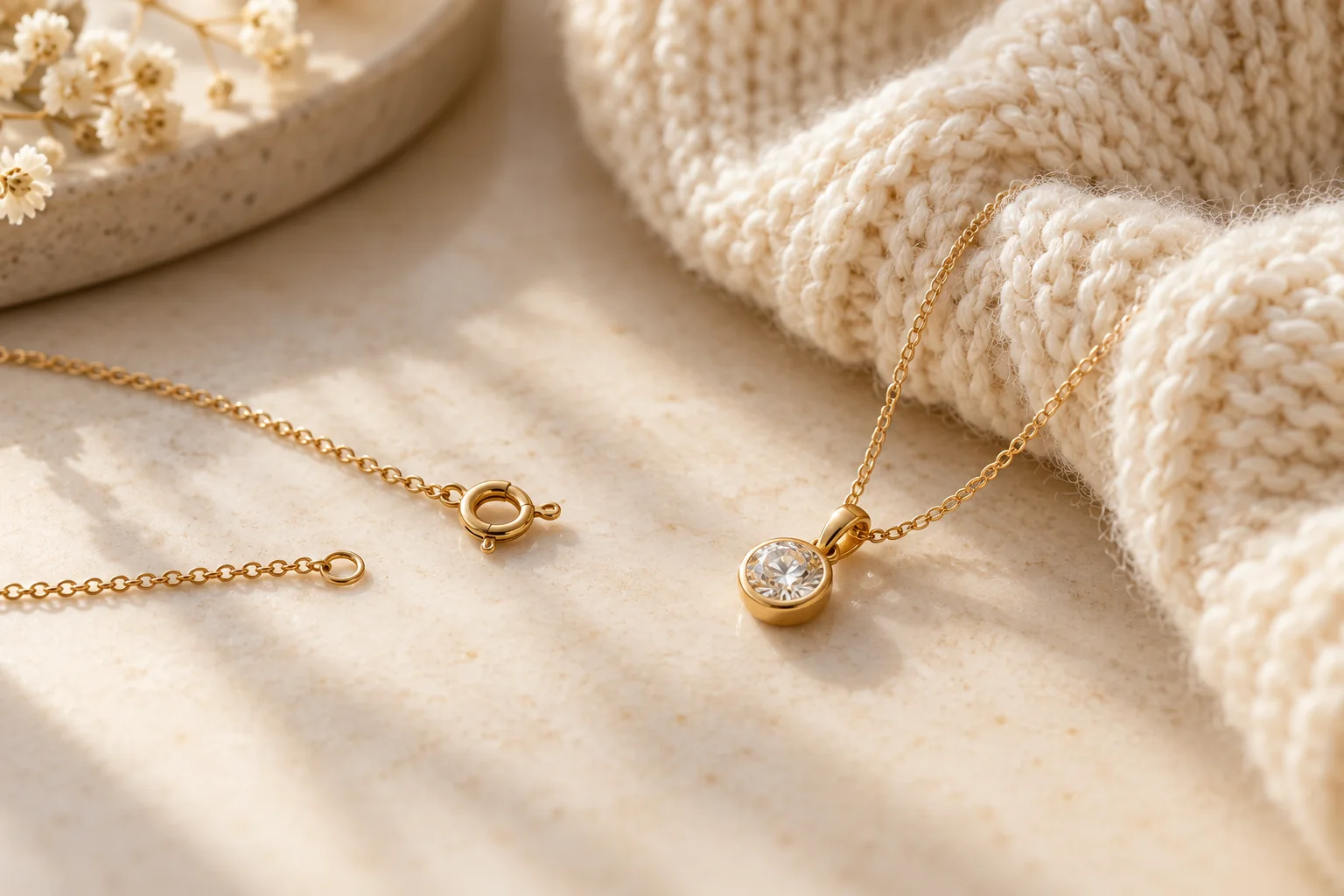
I identify the contact before choosing a solution
I start with what I can see without pulling. I note whether the contact happened at my neckline, shoulder or chest. I also notice whether I was putting the sweater on, taking it off or simply moving. I use that context to narrow the question. I do not turn one caught loop into a judgment about every necklace of the same style.
I distinguish an exposed detail from a suspected defect. A decorative shape may have points that sit poorly beside an open knit. A connecting part may also look different from its original position. I cannot diagnose the construction just by naming the chain. I keep the actual item and the garment in view when I ask a seller or jeweler for advice.
| Observation I make | Next step I choose |
|---|---|
| I see contact at a pendant edge | I stop that outfit pairing and inspect the outline |
| I see contact near the clasp | I check its visible parts without bending them |
| I cannot identify the contact | I keep the pieces separate until I can inspect them clearly |
I do not keep testing against the same sweater. Each extra pass creates another chance to disturb its loops. I can take a clear photograph after the pieces are safely separate. I want that photo to show the specific connection and scale, not just the entire outfit from far away. I also note whether the same necklace has caught other garments. I treat that pattern as useful context for a professional, not proof that I know the cause.
Could an edge or connection need professional attention?
I can mistake repeated catching for a styling issue and keep wearing the piece. I need to notice when the necklace itself deserves a closer look.
I stop wearing a necklace if I see an open connection, loose part, changed shape or persistent catching at one point. I ask a qualified jeweler or the seller about inspection. I do not file, squeeze, glue or coat a part to make it slide over fabric.
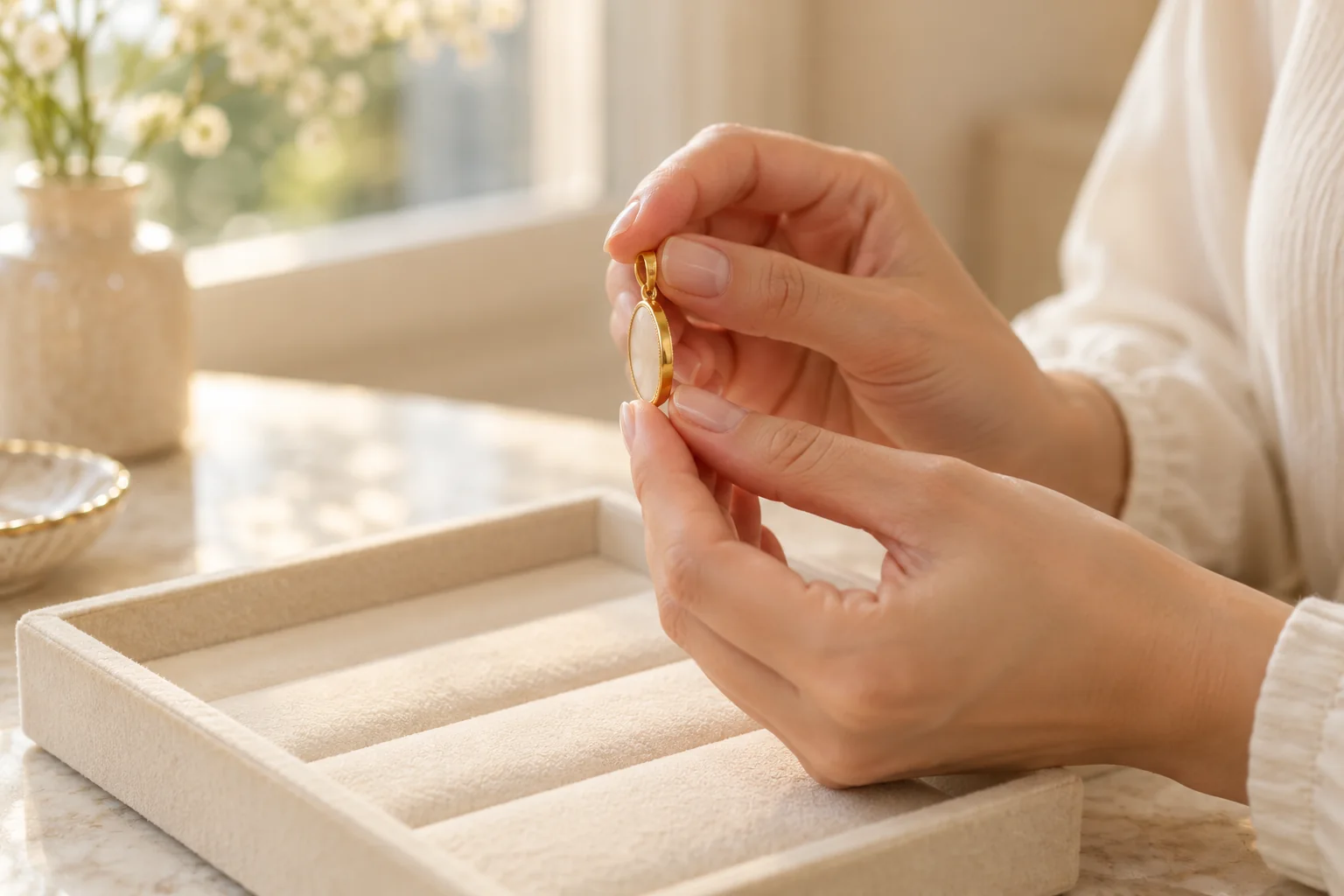
I keep inspection separate from repair
I place the removed necklace on a clean, well-lit surface. I look at the part that caught and compare it with the supplied product image if one is available. I can describe a visible gap or a changed outline. I cannot confirm the condition of a setting or the strength of a joined part from that comparison alone.
I use GIA's ring-setting guidance for a limited point. Its discussion explains that raised prong edges can catch fabric and that qualified jewelers assess snagging prongs.1 I do not turn a guide about rings into a diagnosis of my necklace. I take from it the need to look at the actual exposed part rather than assume that decorative metalwork is harmless around every textile.
I avoid quick fixes that change the piece. I do not press a setting with pliers or put nail polish on a rough edge. I do not know whether that action would affect the finish, a nearby accent or the way the parts join. I would rather keep the necklace aside and ask a precise question about the visible problem.
I can tell the seller which option I own, where the contact occurs and whether anything looks different. I can also ask whether an inspection or repair is appropriate for that construction. I use our clasp handling guide when I need to distinguish an opening mechanism from nearby connections. I do not assume a clasp that is awkward to operate should be forced shut or modified at home.
How do I choose a necklace with a sweater or cardigan?
I can like two pieces separately and find that their contact makes the outfit frustrating. I need to consider the necklace and knit as a pair.
I compare the necklace's actual resting position with my neckline, knit texture and outer layer. I choose a pairing that keeps exposed details away from loops where practical. I do not rely on a fixed chain length or a claim that one chain style can never snag.

I check placement in the complete outfit
I look at where the necklace will sit when I am wearing the clothes normally. I may have a smooth blouse under an open cardigan, a high knitted collar or a loose sweater neckline. I do not expect one arrangement to work the same way in all three cases. I consider the pendant as well as the chain because each part can reach a different area.
I use supplied measurements to estimate placement, then I check the actual fit without pulling or rubbing the piece against the garment. I keep our necklace length guide nearby when I want to compare stated lengths. I do not treat a model photograph as a promise of where the necklace will sit on my body.
| Outfit detail I notice | Choice I consider |
|---|---|
| I wear a loose knitted collar | I choose another necklace or leave the necklace off |
| I wear a smooth inner layer | I check whether the necklace stays clear of the cardigan edge |
| I add a scarf or wrap | I reassess the contact instead of relying on the first outfit check |
I also consider how I will use the outfit. I may remove a cardigan during the day or add a scarf outside. I want a plan for those changes. I can put the necklace away before changing layers instead of assuming it will pass cleanly through every opening. I do not need to label the sweater or necklace a bad purchase. I can reserve each for combinations that are easier to wear and keep an alternative ready for a garment with more exposed loops.
When should I put the necklace on and take it off?
I can create contact while changing clothes even when the finished outfit feels fine. I want a dressing order that gives both pieces more space.
I put on my overhead knitwear before fastening the necklace, and I remove the necklace before taking that knitwear off. I use a clear surface for the removed piece. I do not pull a sweater over a pendant or use the chain to free a caught garment.
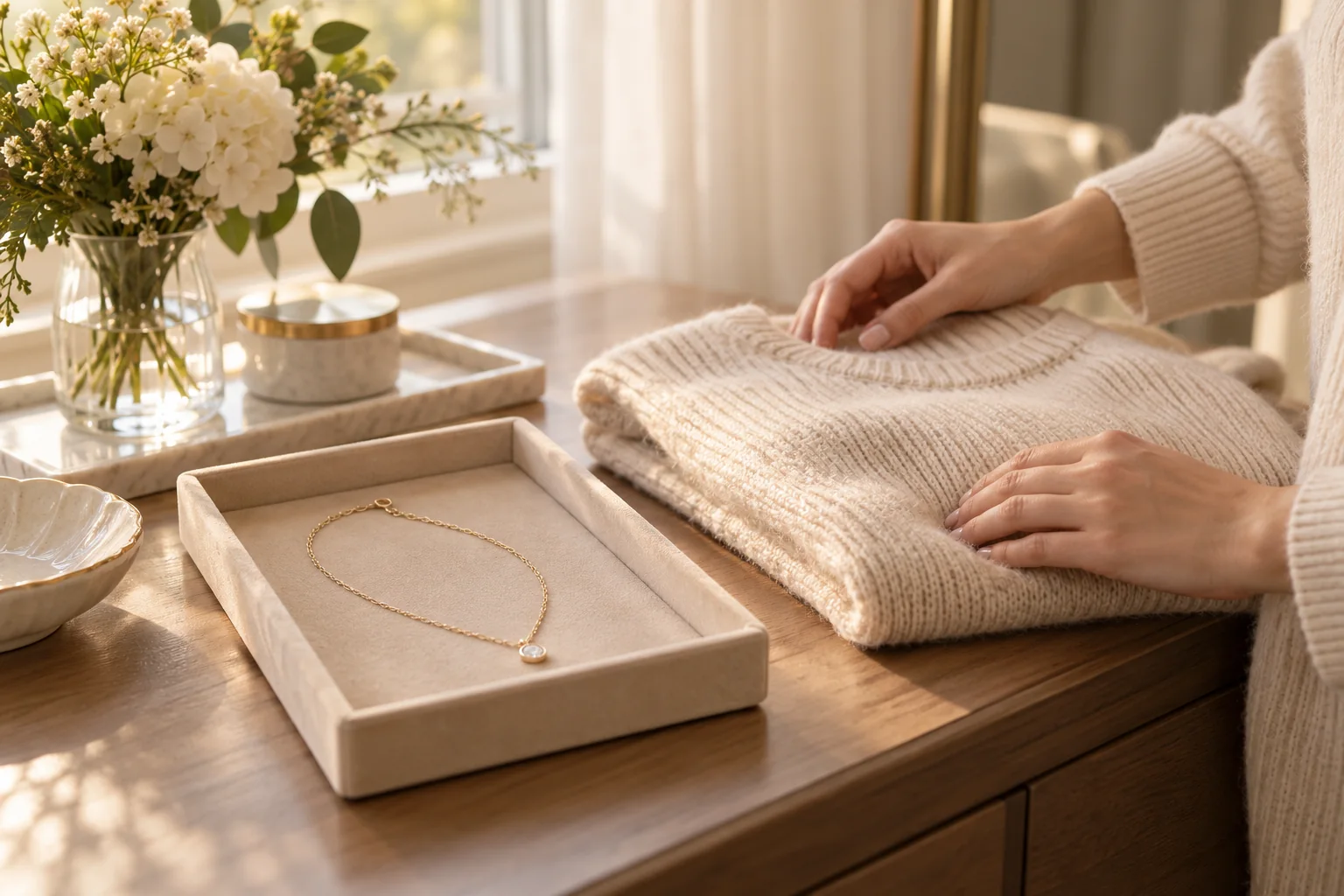
I make changing layers a deliberate step
I set out a place for the necklace before I start changing. I do not want to hold it in one hand while pulling a sleeve with the other. A clear tray or suitable compartment lets me keep the piece away from the garment and see where it is. I keep drinks and open cosmetic containers away from that spot.
I finish the main clothing change before I fasten the necklace. I then check the neckline and any outer layer together. I do not pull the chain tight to force a preferred position. I also avoid assuming that a longer necklace can be slipped over my head. I use the opening method intended for the actual piece.
I reverse that order when I remove overhead knitwear. I open the clasp as instructed, support the necklace and put it down before lifting the sweater. I give a pendant or extender space so that it does not trail across a cuff. I do not rush the step simply because the necklace has passed through the same neckline before.
I follow the item's care instructions after removal. GIA's general jewelry-care guidance supports thoughtful handling and separate storage, while noting that different materials need different care.2 I do not borrow a cleaning method from an unrelated item. I use our Textured Stainless Steel Chain Necklace Collection as an example of a listing whose exact option and supplied care details I read before handling. I keep its chain appearance separate from any promise about performance beside a particular sweater.
What should I do if the necklace and fabric are already caught?
I can react to a caught loop by pulling harder and make the contact tighter. I need to stop the movement before deciding what I can safely do.
I stop pulling and support both the garment and necklace. I release only contact that separates easily without force. I leave a tight or unclear snag alone and seek suitable help for the jewelry or knitwear. I do not cut, twist or bend parts while wearing the joined pieces.
I protect the pieces before trying to separate them
I first stop the motion that caused the snag. I do not keep lifting the sweater or turning my body to see whether the contact will release. I support the fabric close to the caught area so that its weight does not keep pulling. I also avoid letting a pendant hang from the single loop involved.
I look for a simple, visible contact rather than start a repair. I may find that the fabric rests loosely beside a decorative detail and separates without resistance. I do not assume every snag is that simple. I stop if I cannot see the route clearly or if the loop tightens when I move either piece.
| Situation I see | Boundary I keep |
|---|---|
| I see loose contact that releases easily | I separate the pieces without tugging |
| I feel resistance or see several joined loops | I stop and ask for help |
| I see a changed jewelry part afterward | I set the necklace aside for assessment |
I avoid household scissors, needles and pliers around joined pieces that I am still wearing. I do not want to exchange one small problem for a cut garment or bent connection. I can ask a jeweler about the necklace and a suitable knitwear specialist about the fabric. I keep those tasks separate because expertise with one item does not automatically cover the other.
I inspect both items after they are safely apart. I note a loose loop, a missing accent or an altered connection without trying to conceal it. I choose another outfit pairing until I understand what happened. I do not use repeated snagging as a reason to pull the necklace tighter against my neck or keep testing the same vulnerable area.
Conclusion
I find the contact point, check the actual necklace and choose a kinder outfit pairing. I stop repeated catching and seek help before changing or damaging either piece.
- GIA's guide to ring settings discusses fabric-catching prongs in rings; it does not assess a specific necklace. ↩
- GIA's jewelry-care guidance covers handling and storage with attention to material differences. ↩
Images are AI-generated editorial illustrations. They do not identify or verify a specific product.