
How Do I Read a Silk Bonnet Size Chart Without Guessing?
I can compare two bonnet charts and find numbers that seem impossible to match. I want to know what each number describes before choosing a size.
I identify whether the chart gives a head range, opening measurement, crown width or pouch length. I check the units and whether the item is relaxed or stretched. I compare matching measurements only, and I ask the seller to explain an unclear number rather than treat it as a guarantee.
I use this guide to read the information before buying. I keep the later comfort check separate, because even a clear chart cannot tell me exactly how a bonnet will feel.
Which part of the bonnet does the number describe?
I can mistake a roomy crown measurement for the opening that will sit around my head. I name the measured part before comparing the figures.
I look for a label beside every number. I separate the recommended head range from the opening, the crown and any long pouch. I do not assume that width means circumference or that a size name such as large refers to the same part across different sellers.
I turn a row of numbers into named measurements
I begin with the diagram, if the seller provides one. I look at where each arrow starts and ends. I want to know whether it crosses the whole crown, follows the edge or runs from the opening to the end of a pouch. Those are different routes. I cannot compare them just because their numbers appear beside the same size name.
I then check whether a figure describes the product or the person expected to wear it. A recommended head range is different from a bonnet opening measured on a table. LS Silk's own size page, for example, distinguishes relaxed and stretched opening measurements within its sizing explanation.1 I use that as one brand-specific example, not a Zolay size chart or a promise about another bonnet.
| Label I find | Question I ask |
|---|---|
| I see head circumference | I ask whether it is a recommended wearer range |
| I see crown diameter | I ask how the crown was placed for measurement |
| I see pouch length | I keep it separate from opening fit |
I save the labels with the numbers. A screenshot of only the size row may remove the diagram that made it meaningful. I also keep the exact product option in view, because one listing can contain different shapes. Our general bonnet-choice guide helps me compare the whole item after I understand the chart. I use this first step to make the information comparable, not to choose a size from a single impressive-looking number.
How do I compare inches and centimeters correctly?
I can think two charts disagree when they simply use different units. I put the figures on one scale before drawing a conclusion about size.
I use one unit consistently and keep the original labels beside my conversion. I multiply inches by 2.54 to obtain centimeters, or divide centimeters by 2.54 to obtain inches. I keep reasonable rounding and remember that a precise conversion cannot improve an approximate product measurement.
I convert the unit without changing what was measured
I copy the original figure and unit before using a calculator. NIST lists the inch-to-centimeter conversion factor as 2.54.2 I use that factor for length measurements only. I still need the two numbers to describe the same part of the bonnet. Converting a crown width into centimeters does not turn it into a recommended head circumference.
I can use a simple invented example to check my calculation. A stated length of 20 inches converts to 50.8 centimeters. That example explains the arithmetic; it is not a Zolay measurement or a size recommendation. If the seller calls its figure approximate, I preserve that wording rather than add decimals that make the product seem more precisely measured than it is.
I also check how the chart presents ranges. I convert both ends with the same method. I do not convert only the larger number and assume the smaller one follows a different rule. If two versions of the same chart differ after conversion, I ask which version applies to the exact option rather than select whichever range makes my purchase easier.
I keep my comparison readable. I record the original number, its unit, the named part and the converted value in one place. I avoid a separate list of bare numbers that I could later mix up. This takes little time, and it prevents a unit difference from becoming a false conclusion that one bonnet must be much larger, tighter or more suitable than another.
Why is a flat width different from a head measurement?
I can double a flat measurement or use a circle formula and feel certain about fit. I first check whether that simple shape actually describes the item.
I treat a flat product width as the dimension the seller measured in that position. I do not turn it into a wearer range without the maker's explanation. A gathered opening, shaped crown, seams and elastic can make a shortcut unreliable for the finished bonnet.
I keep the measurement method attached to the result
I look at how the item lies in the size photograph. The seller may have spread the crown flat while leaving the gathered opening underneath. It may instead show the opening edge with the rest of the bonnet folded away. Those photographs can produce very different widths. I need to know which view belongs to the figure before I use it in a comparison.
I avoid treating a bonnet like a perfect rigid circle. I can understand the geometry of a circle without assuming that gathered fabric and elastic follow that shape in use. A formula does not tell me how the band was held, whether the fabric was pulled or how much usable space remains around the seams. I ask for the measured route rather than reverse-engineer it from one photograph.
| Measurement I receive | Shortcut I avoid |
|---|---|
| I receive a crown width | I do not call it a head range |
| I receive a flat opening width | I do not assume how it was stretched |
| I receive a long pouch dimension | I do not use it as a band-size answer |
I also separate opening size from hair room. Our crown-capacity guide explains why the space for lengths is a different question. A chart can answer one of those questions well while leaving the other unclear. I do not solve the missing part by choosing the largest number. I keep it as a specific question for the seller so that my eventual choice rests on the finished shape I will actually receive.
What does a relaxed or stretched range tell me?
I can focus on the largest stretched number and overlook how the opening is meant to sit. I want the range's meaning before testing its limit.
I ask whether the figures describe the item's measured opening or the maker's recommended wearer range. I check how the adjustment works. I do not treat maximum stretch as a comfort target, and I do not stretch the bonnet repeatedly to reproduce a listing's number.
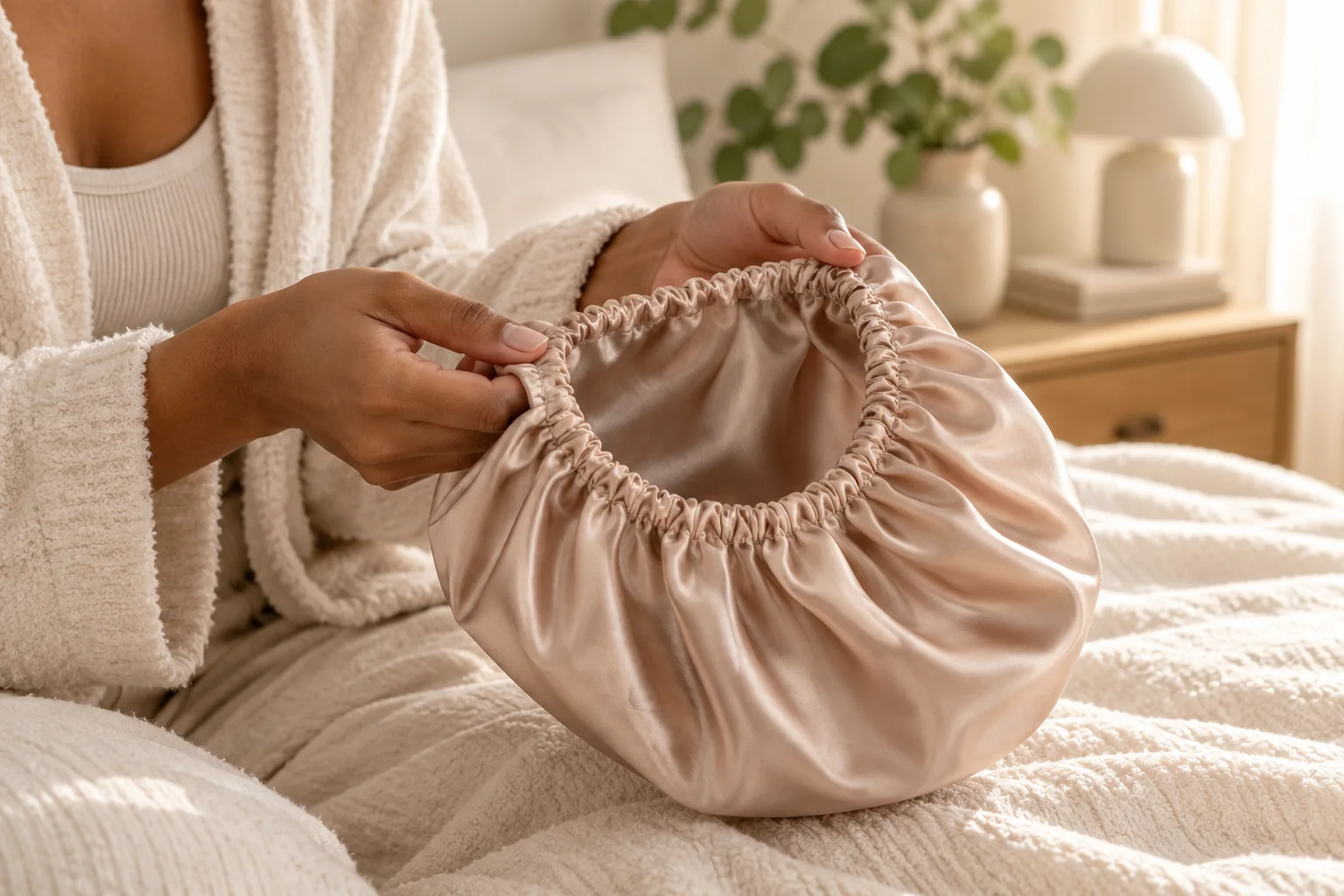
I distinguish a possible dimension from a practical choice
I read the sentence around the range, not only the numbers themselves. A listing may describe how far an opening can stretch during measurement. Another may state the head sizes for which the maker recommends the bonnet. I cannot assume those statements mean the same thing. I want the seller to identify which one it has provided and whether it applies to the exact closure option I selected.
I check whether an adjustment changes the opening or merely changes how the ties sit. I do not assume that every drawstring, ribbon or elastic band offers the same usable range. I also avoid pulling a new item to its stated maximum just to prove that the chart is correct. I can ask for the measurement method without making my own repeated stretch trial part of the purchase.
I keep comfort outside the arithmetic. A number within a stated range may help me narrow the options, but it cannot tell me how a seam, band or fastening feels against me. I do not plan to use more tension because I am close to an endpoint. I can choose an option with clearer information or decide not to buy until the uncertainty is resolved.
I record any unanswered question before comparing another listing. That stops an unknown range from silently becoming an assumed feature. I want to compare confirmed facts with confirmed facts. I do not need to call one product unsuitable when the real issue is that its description has not yet given me enough detail to make a useful comparison.
What should I ask when the size chart is unclear?
I can send a seller my head measurement and still receive a vague size suggestion. I want the question to identify the missing product detail too.
I name the exact item and option, quote the label and ask where and how that measurement was taken. I request the recommended head range and crown information separately. I keep the reply with the listing, and I check current purchase terms before assuming I can assess fit through wear.
I make the missing detail easy to answer
I can ask a short question that contains the exact ambiguity. I might ask whether a listed width crosses the crown or the opening, and whether the bonnet was relaxed when measured. I do not need to send a long history of every bonnet I have considered. I want the answer to connect one number to one part of the item.
I include the selected style, closure and size name. If the page has several options, I attach the relevant screenshot or quote the option wording. I avoid assuming that an answer about one shape applies to every bonnet in the collection. I also ask whether the chart is current if the description and image seem to use different labels.
| Detail I include | Answer I need |
|---|---|
| I identify the exact option | I need the matching chart |
| I quote the unclear dimension | I need its route and measurement state |
| I ask about head and hair room | I need separate information for each |
I keep useful replies with the listing. Our product-detail record guide explains a simple way to preserve the option and its description. I do not use that record to invent a guarantee or extend the seller's terms. I use it so that my choice remains traceable when I return to the comparison later. If the essential measurements stay unclear, I can leave the purchase undecided instead of asking a size name to answer a question it cannot resolve.
Conclusion
I name the measured part, align the units and check the measurement state. I ask about missing details before treating a bonnet chart as a useful comparison.
- LS Silk, How to Choose the Right Silk Bonnet Size. I use its relaxed-versus-stretched explanation as one brand-specific example, not Zolay sizing. ↩
- NIST, Guide to the SI: Conversion Factors. I use the listed inch-to-centimeter factor, not a bonnet-fit rule. ↩
Images are AI-generated editorial illustrations. They do not identify or verify a specific product.