
Should I Remove My Necklace Before I Take a Shower?
I can read stainless steel on a necklace listing and assume the whole piece welcomes water. A finish or decorative part can make that assumption unhelpful.
I remove my necklace before showering when its care instructions say to avoid prolonged moisture, cosmetics or household chemicals. I check the complete piece, including its finish and decorative parts. I do not turn stainless steel or gold-tone into a waterproof guarantee when the seller has not established one.
I write the Zolay Nights Journal from an everyday care perspective. I want a clear decision before I turn on the shower, and a gentle next step after an accidental splash. I separate that decision from choosing a color or comparing necklace lengths.
Does stainless steel mean my whole necklace is waterproof?
I can focus on the chain's base material and overlook its finish. A single material word does not describe every part that needs care.
I read stainless steel as a base-material statement when the listing uses it that way. I check any coating, clasp, pendant, setting and decorative material separately. I need clear item-specific water guidance before treating the finished necklace as suitable for showering or swimming.
I read the finished piece rather than one word
I begin with the product details for the exact style I selected. A collection page can contain several different link shapes and finishes. I check the numbered option rather than borrow information from another necklace in the same group. I also distinguish a named base material from a claim about the whole item's use. Stainless steel does not tell me the decorative material, coating method or every connection in a finished necklace.
I read color words carefully. Gold-tone describes an appearance unless the listing states more. I do not infer solid gold, a specific plating thickness or a particular coating process. Silver-tone does not establish sterling silver either. If I need those details to judge an intended use, I ask the seller before I wear the piece that way.
| Listing detail | What it tells me | What I still need |
|---|---|---|
| Stainless steel base | I know the stated base material | I need finish and care details |
| Gold-tone or silver-tone | I know the stated color | I need any specific coating information |
| A decorative pendant | I know the design has another part | I need that part's material and care |
I use the current Zolay Nights chain collections as a concrete example. Their descriptions state a stainless steel base and assorted gold-tone or silver-tone finishes. Their care instructions ask me to avoid prolonged moisture, perfume, lotion and abrasive cleaners. I follow those instructions instead of replacing them with another seller's waterproof wording.
I also keep general jewelry guidance within its scope. GIA explains that jewelry materials can need different care.1 I use that point to inspect all parts. I do not transfer advice for a natural pearl, a gemstone or solid precious metal to an unidentified decorative part.
Why do I take off a necklace before showering?
I can remember to protect my necklace after I have already applied shampoo. A simple removal routine helps me follow the care instructions before exposure.
I remove a necklace before showering when the maker advises avoiding moisture or cosmetics. I place it in a dry, separate location away from the sink and shower. I handle the clasp gently and put the piece back on only when my skin and any products are dry.
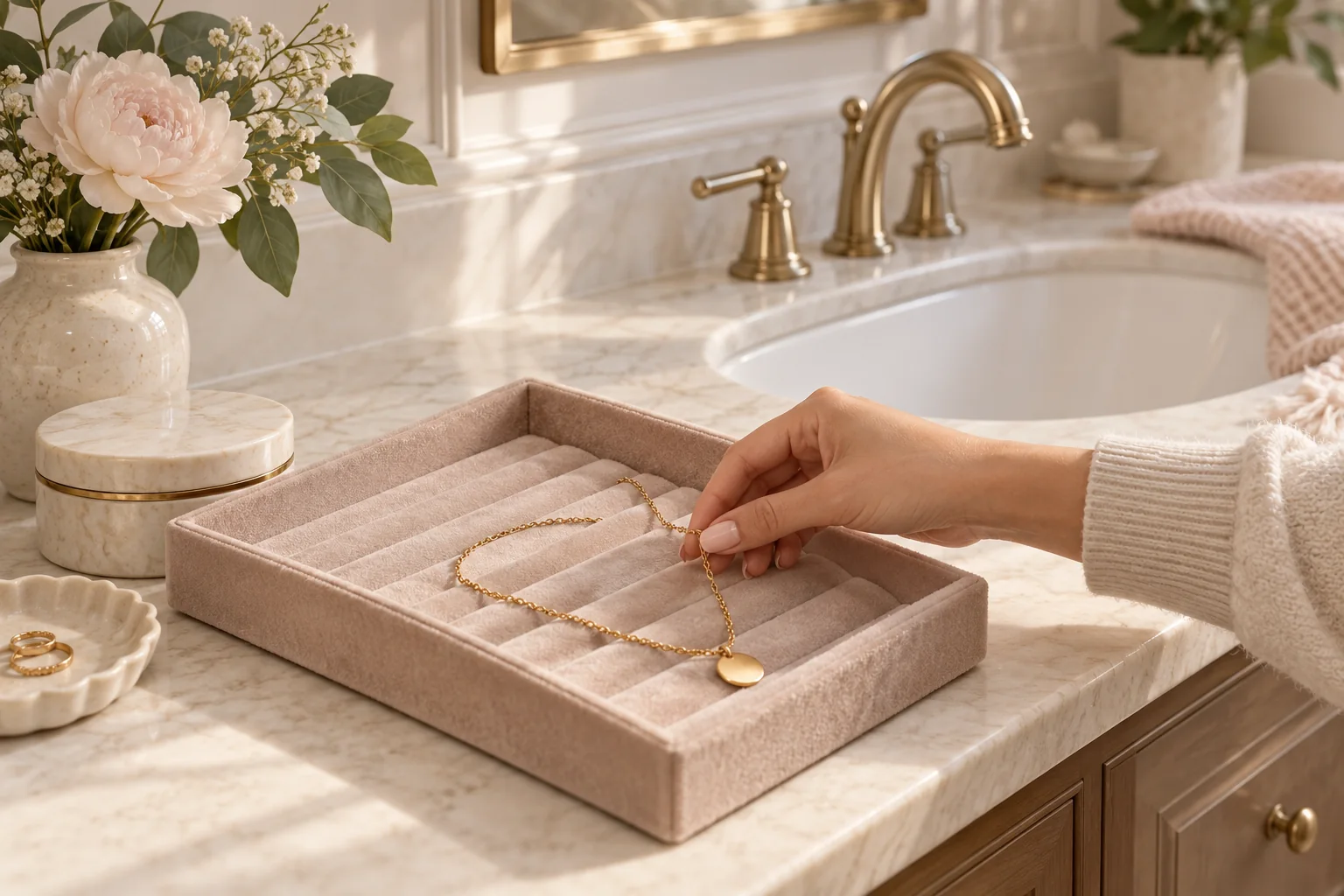
I make removal easy to remember
I choose the storage spot before I need it. I prefer a dry tray or separate compartment outside the wet area. I do not leave a chain on the edge of a sink where it can slide toward the drain. I also keep it away from open cosmetics. A care routine works better for me when I do not need to search for a place to put the necklace each time.
I undo the clasp with the piece supported. I do not pull the chain over my head to save a few seconds when the closure is designed to open. I set the necklace down without sharply folding a flat chain. I separate it from other pieces so that removal does not create a tangle I need to fix later. I use the materials and care page as a starting point, then follow the specific item's instructions.
I keep the shower decision separate from a claim that one brief contact will ruin every necklace. I cannot predict an exact outcome from the base material alone. My reason for removing the piece is that its instructions set a clear limit. I do not need to run my own water experiment to see whether I can exceed that limit.
I wait until I am dry before putting it back on. I let perfume and lotion dry too, according to the item's guidance. GIA discusses chemical exposure and the care needs of different jewelry materials.1 I use that small practical point without presenting a guarantee of permanent shine. If daily removal feels inconvenient, I choose fewer pieces for that routine rather than assume an unclear waterproof claim solves the problem.
What do I do if my necklace gets splashed by accident?
I can panic after a splash and reach for a strong cleaner. An improvised treatment can add a second problem to a small care mistake.
I follow the item's instructions after accidental water contact. I support the necklace, gently remove surface moisture with a suitable soft cloth, and let it dry fully before storage. I ask the seller if cleaning guidance is unclear or I notice a changed finish or damaged part.
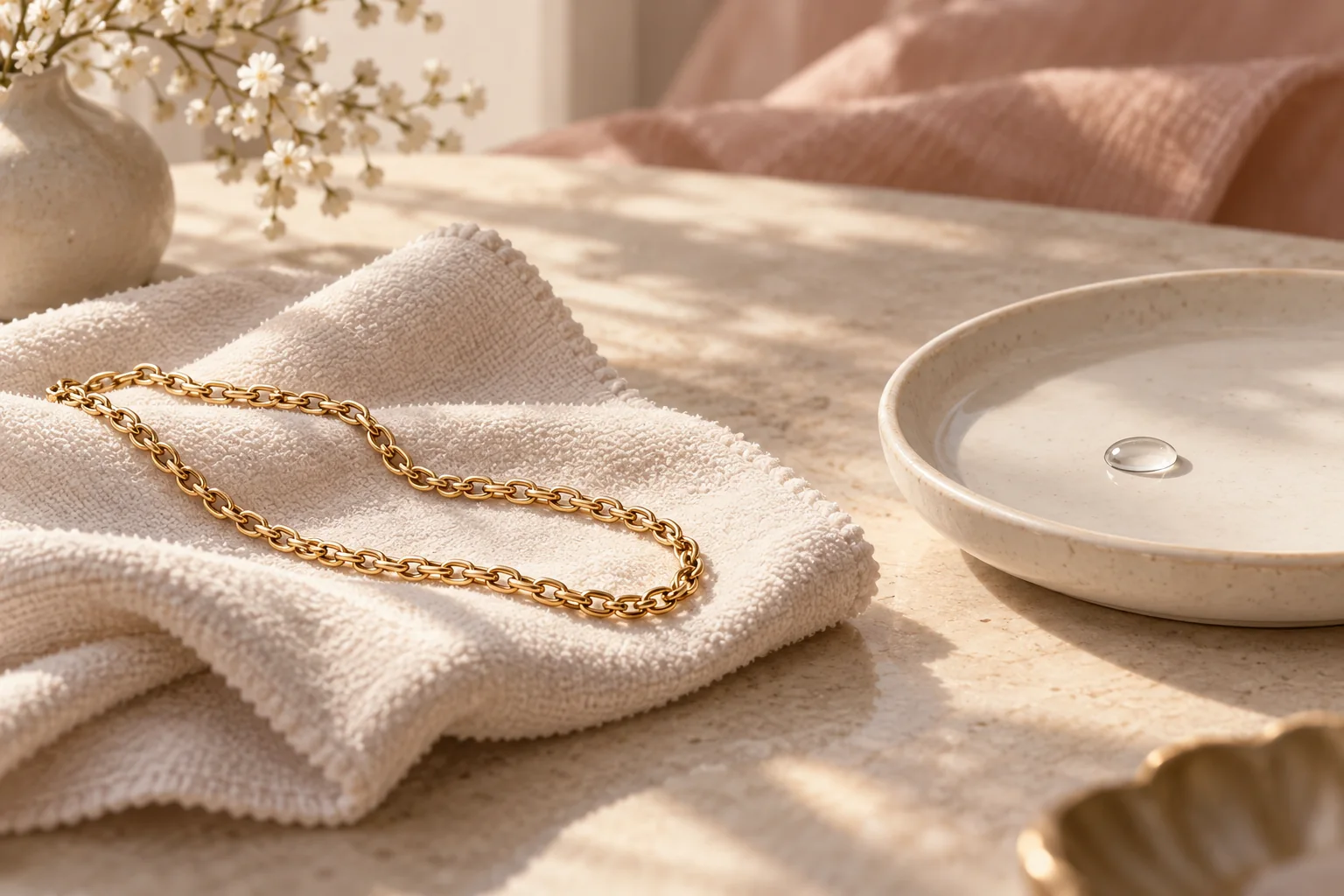
I avoid turning a splash into a cleaning experiment
I first move the necklace to a stable, dry surface. I check what happened without pulling the links apart. I distinguish a brief splash from a soak or contact with a cleaning product. I describe that difference if I need help. I do not assume that every kind of exposure calls for the same response.
I use a soft cloth that suits the maker's instructions. I blot gently instead of rubbing hard, and I support a fine chain rather than drag it through the cloth. I do not use heat to speed up drying. I also do not reach for toothpaste, baking soda, an abrasive polishing pad or a general metal cleaner. A recipe for another material does not tell me what is suitable for this finish.
| What happened | What I do first | What I avoid |
|---|---|---|
| Brief plain-water splash | I follow the care instructions and remove surface moisture gently | I avoid aggressive polishing |
| Contact with cosmetics | I check the permitted cleaning method | I avoid guessing with a household cleaner |
| A changed finish or loose part | I stop handling it and ask for guidance | I avoid trying to repair it myself |
I leave the piece in a clean, dry place while it finishes drying. I do not seal a damp necklace in a pouch. I inspect the clasp and pendant after drying if the instructions permit ordinary handling. I do not force a connection that feels different.
I cannot promise that a careful response reverses a finish change. I can prevent myself from adding an unsupported cleaning method. If I notice an issue, I keep a clear photo and describe the exposure honestly. I ask about the actual piece rather than request a universal answer for all stainless steel jewelry.
How do I judge a changed finish without making assumptions?
I can see a darker spot and decide that the base metal has failed. A surface change needs clearer information than a quick label.
I look at the changed area in good light and compare it with the original product description. I separate surface residue, finish changes and physical damage as possible observations, not diagnoses. I ask for item-specific guidance before polishing, soaking or replacing a component.
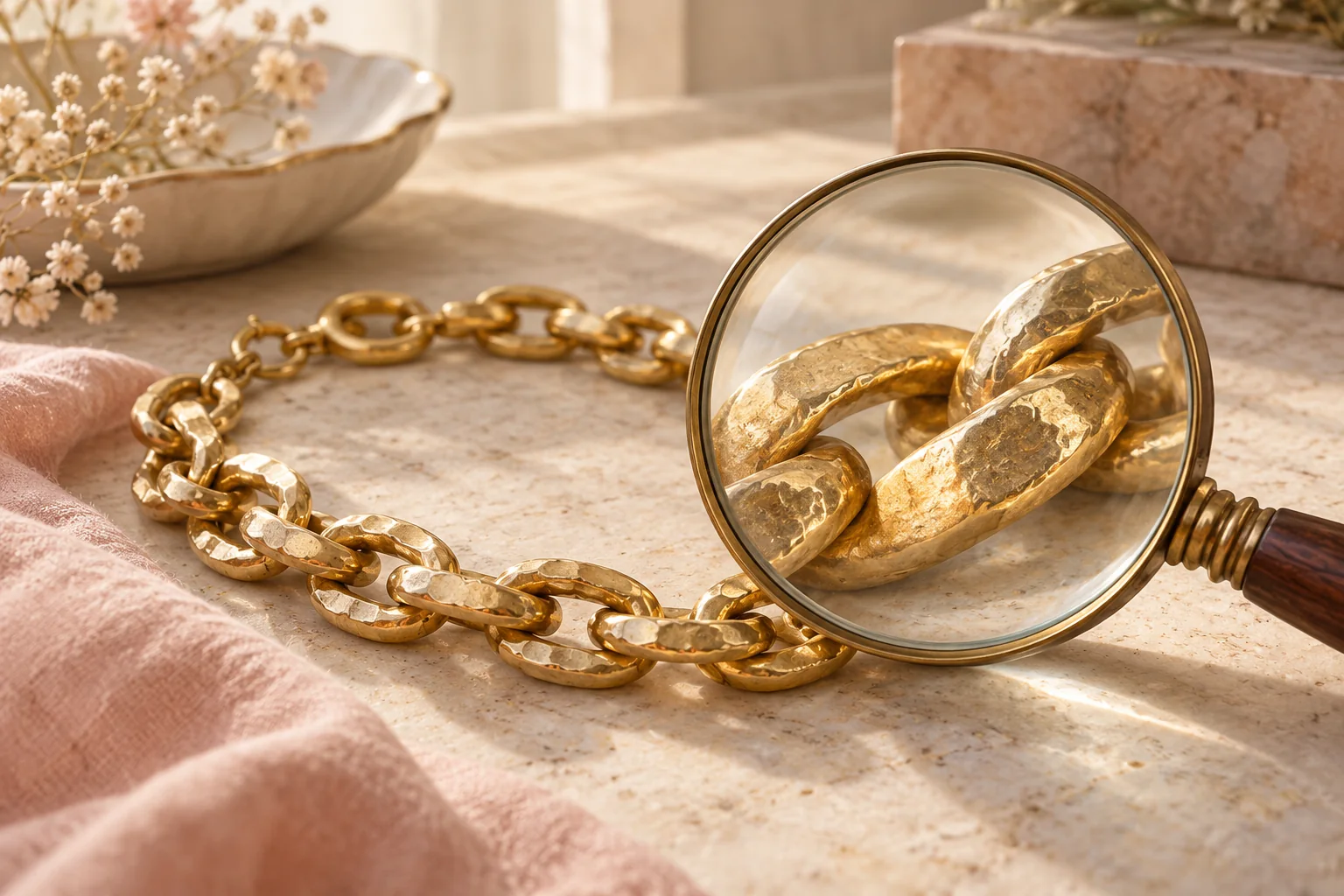
I record what I can actually see
I describe the location and appearance first. I might notice that one link looks different from the others or that a pendant edge feels rough. I do not use a color change alone to identify a metal or decide what caused it. A photograph can document an observation, but it cannot verify the composition of a chain or the chemistry of a surface change.
I check whether the listing states a plated finish. The current Essential Stainless Steel Chain Necklace Collection notes that plated finishes can change over time with wear and care. I keep that statement specific to the collection. I do not turn it into a claim that every gold-tone item uses the same plating or that every change has the same cause.
I use two pictures when I ask for help: one shows the whole piece and one shows the area I am concerned about. I take them in ordinary light without filters. I do not scrape the surface to reveal what is underneath. I do not run a magnet, acid or scratch test as a way to prove an online material claim. Those actions can damage the piece and still leave me with an incomplete answer.
I read the full listing rather than only the advertising phrase. The FTC's online shopping guidance recommends checking product details and keeping purchase records.2 I use that habit to retain the description I relied on when ordering. I do not treat a saved listing as a guarantee that any complaint will have a particular outcome. I use it to make my question precise: I want to know the intended care for this finish and what the seller recommends for the change I can see.
How do I store my necklace after my shower routine?
I can remove my necklace carefully and leave it in a damp room. Storage needs to support the same care decision I made before showering.
I store my necklace fully dry, separate from other pieces, and away from prolonged moisture and cosmetics. I support its natural shape and avoid sharp folds or pressure on decorative parts. I keep a simple routine that matches the item's own instructions.
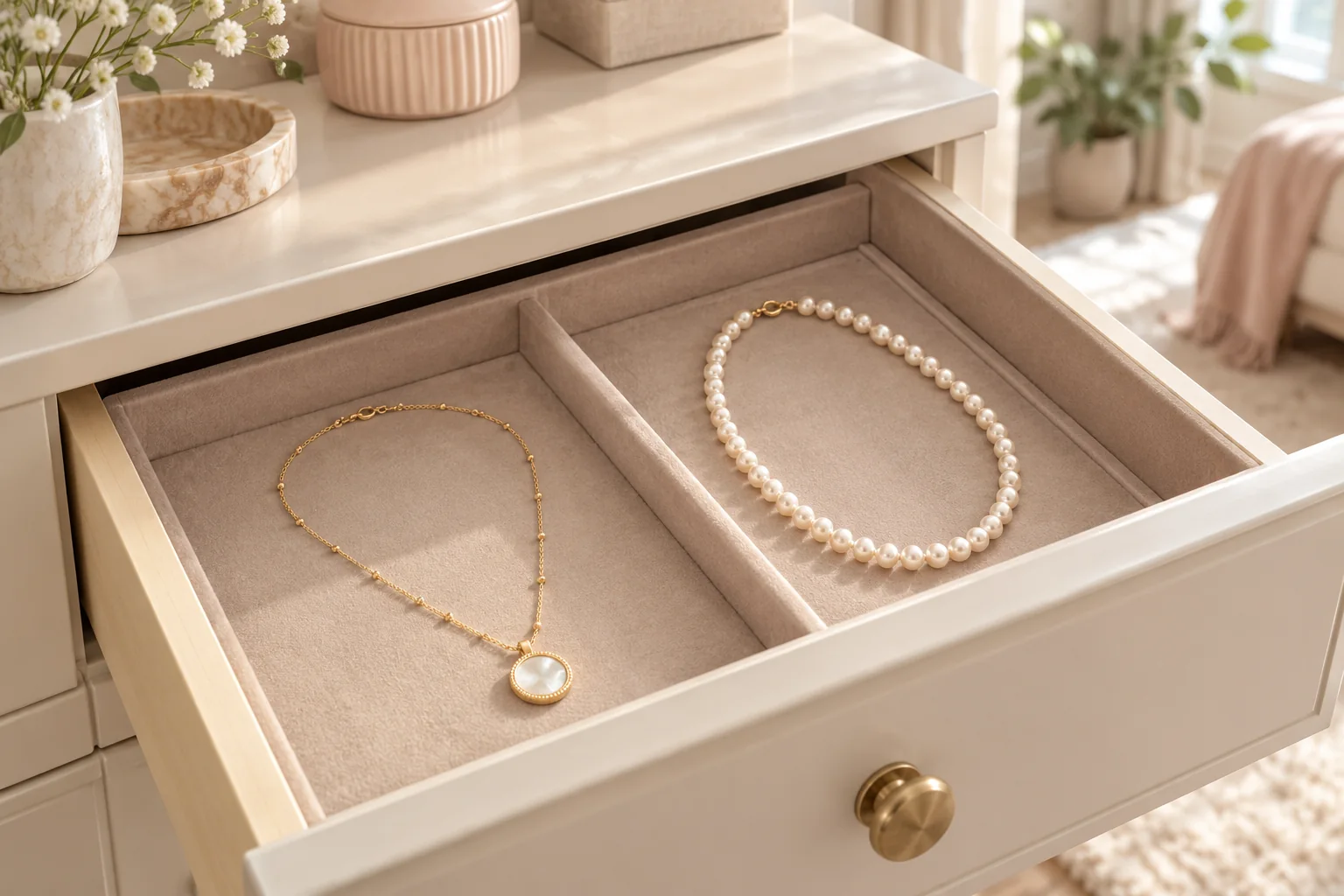
I choose a dry place with a clear role
I move the necklace back to its usual dry storage after use. I do not make the bathroom ledge its permanent home simply because I remove it there. I choose a compartment that holds the piece without squeezing the pendant or bending the chain into a sharp corner. I let the design's shape guide the arrangement rather than force every necklace into the same small box.
I keep each piece separate. I do not pile a fine chain under a heavier pendant, and I do not rely on a clasp alone to stop several loose necklaces from tangling. I use the travel-storage guide when I need a portable version of this routine. I keep daily storage simpler than a travel setup when the necklace will stay at home.
| My storage check | What I want to see |
|---|---|
| Moisture | I want the necklace and its storage surface dry |
| Shape | I want the chain supported without a sharp fold |
| Separation | I want the piece away from rubbing against other jewelry |
I check the necklace briefly before the next wear. I notice a clasp that does not close normally or a link that seems caught. I stop and ask for guidance if I find damage. I do not force a closure because I am rushing to leave.
I browse the Jewelry collection with maintenance in mind as well as appearance. I read the actual care statement for each item. I do not choose a piece for uninterrupted wear unless the seller clearly supports the uses I have in mind. I can enjoy an everyday necklace and still remove it for the shower. Everyday describes its place in my routine; it does not replace the finished item's care limits.
Conclusion
I remove my necklace when its care instructions require it. I check every material, handle splashes gently, and store the finished piece dry and separate.
- GIA: Tips on Caring for Jewelry. I use its material-specific care and cosmetics guidance without applying gemstone advice to unidentified parts. ↩ ↩
- FTC: Online Shopping. I use its advice to read product details and keep purchase records. ↩
Images are AI-generated editorial illustrations. They do not identify or verify a specific product.