
Does a Mesh Laundry Bag Make My Silk Bonnet Machine Washable?

I want a quicker wash, but I worry that a zipped bag gives me false confidence. I check the bonnet instructions before choosing the machine.
I do not treat a mesh laundry bag as permission to machine wash silk. I follow the care instructions for my exact bonnet. If those instructions allow machine washing, I use a suitable bag as an extra handling aid, while keeping the permitted cycle, detergent and drying method separate.
I work through five decisions below. I start with permission, because choosing a bag is useful only after I know the bonnet can enter that wash.
What do I check before putting my bonnet in the bag?
I can find confident washing advice for a different bonnet and miss my own label. I check the exact item before copying another person's routine.
I read the sewn care label and any matching manufacturer instructions. I check whether they allow machine washing, require hand washing or specify another method. If the instructions conflict or are missing, I ask the seller before using the machine. A bag does not resolve that uncertainty.

I separate the item label from the bag label
I may own a bag that says it suits delicate clothing. That statement describes the accessory. It does not describe the bonnet inside it. I need instructions for the finished bonnet, which may include a band, lining, ties and several materials. I do not infer care from the shiny surface or from the word satin alone.
I read each care symbol as part of the whole label. GINETEX explains that washing symbols distinguish permitted washing treatments and that bars indicate reduced mechanical action.1 I use that guide to understand a symbol. I still follow the treatment shown on my item rather than select a symbol that sounds convenient.
| Information I find | What I do with it | What I avoid assuming |
|---|---|---|
| Machine washing is expressly allowed | I check the stated conditions | I do not use any cycle I like |
| The label specifies hand washing | I follow that method | I do not replace my hands with a mesh bag |
| The instructions are unclear | I ask about the exact item | I do not copy a similar-looking listing |
I keep a photo of the label with the order details. That record helps if the listing later changes. I ask a focused question such as, “Does this exact bonnet allow machine washing, and under which conditions?” I include the model or order reference, so the reply concerns my item.
I also check for damage before washing. I do not expect the bag to repair a loose seam or a pulled thread. My guide to a pulled thread on a silk bonnet helps me separate a condition question from a cleaning decision. If the item needs assessment, I settle that question first.
What can a mesh laundry bag actually change?
I can mistake a layer of mesh for a shield against every part of washing. I list what still reaches the bonnet before trusting that layer.
I use a bag to keep a permitted item contained and reduce direct contact with other pieces. I do not expect it to control water temperature, detergent chemistry, the washer's movement or drying heat. I manage those conditions through the bonnet instructions and the machine controls.
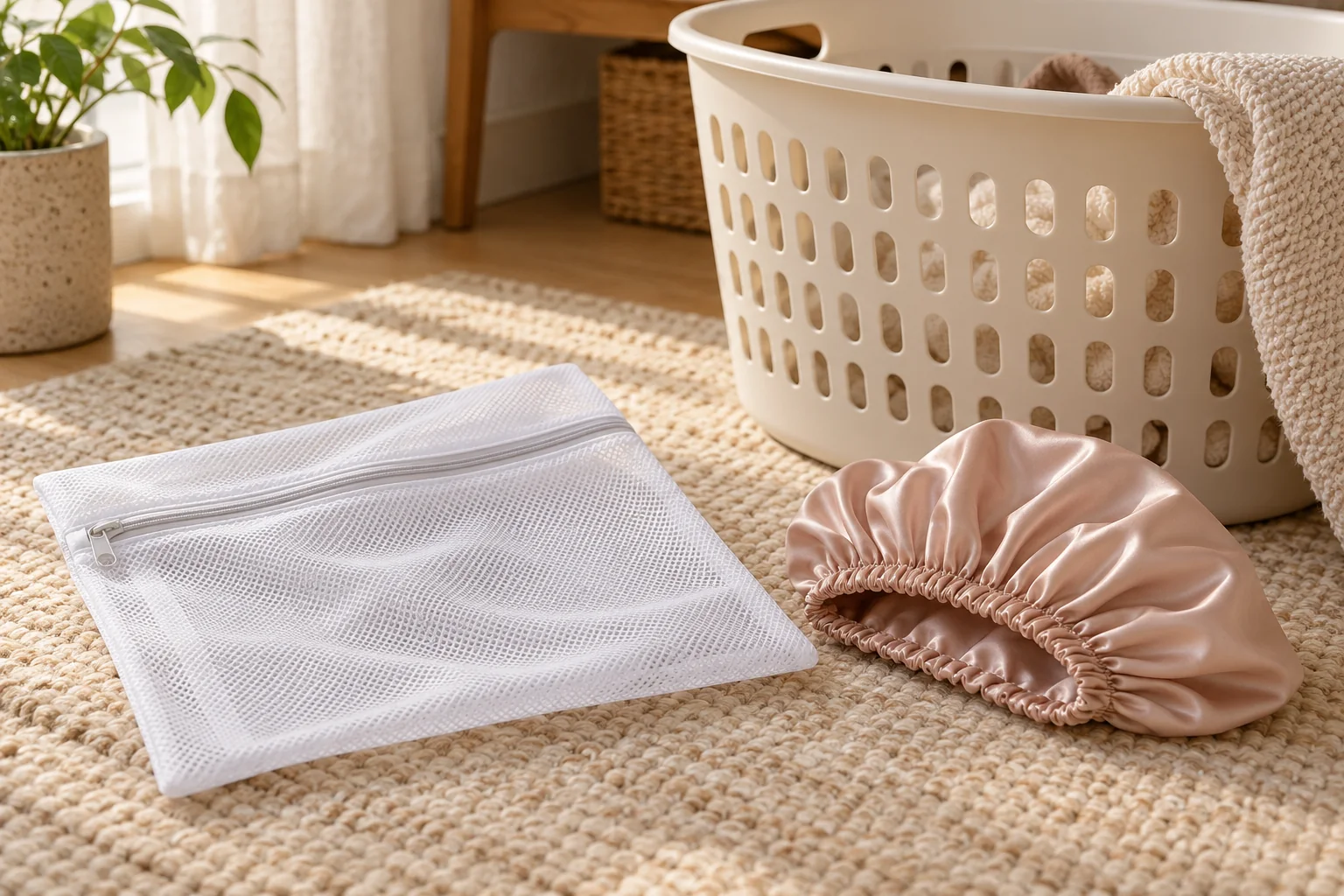
I keep containment separate from care permission
I think of the bag as one part of a wash plan. Its mesh allows water through, so the bonnet still enters the wash environment. I cannot make an unsuitable detergent suitable by putting fabric behind that mesh. I cannot turn an overly warm setting into a cooler one by closing the zipper.
Whirlpool's sorting guide tells readers to check care instructions and set aside pieces that require hand washing or dry cleaning. It also includes mesh bags among optional laundry supplies.2 I use that order of decisions: I sort by what the item permits, and then I consider an accessory. I do not read the presence of a bag in a laundry guide as an approval for all silk.
I also consider the rest of the load. A contained bonnet still shares the water with other items. I check whether their permitted conditions match, and I avoid treating a mixed load as suitable just because its smallest item has a bag. I do not add a delicate item to a cycle designed around heavily soiled, sturdy pieces.
I make the distinction concrete by asking two separate questions. I ask whether the bonnet is allowed in the machine at all. I then ask whether the bag and the planned load make sense within that permission. If the first answer is no, I stop planning a machine wash. If the second answer is unclear, I change the plan instead of assuming that the bag will compensate.
I make no promise that a bag prevents all snags, changes in shape or other damage. I have not tested every bonnet, bag and washer combination. I use the instructions and the item's condition to make a practical decision with limits I can explain.
Which bag details do I inspect if machine washing is allowed?
I can buy a bag for its size and miss a rough closure or damaged seam. I inspect the accessory before it touches the bonnet.
I choose a clean, intact bag that suits the permitted wash and holds the bonnet without tightly packing it. I check the mesh, seams and closure for rough or broken parts. I follow the bag's own instructions and replace a damaged bag rather than treat it as protection.

I inspect the contact points
I look inside the bag, because that is where the bonnet will sit. I check whether a zipper edge or broken thread could catch the fabric. I inspect the corners and seams as well as the large flat areas. A good-looking front panel tells me little about a damaged closure on the other side.
I do not use a rigid rule that every bag needs the same mesh size or shape. I consider the bonnet's ties, fastening and any details that could work through an opening. I follow the accessory maker's directions where they address these features. If the bag seems poorly suited to the item's construction, I choose another suitable option within the care instructions.
| Bag detail | My inspection | My decision if it fails |
|---|---|---|
| Mesh and seams | I look for holes and rough areas | I use an intact bag |
| Closure | I check that it works and follows its design | I do not improvise a sharp repair |
| Usable space | I check that the bonnet is not tightly stuffed | I choose a suitable size |
I keep the bag clean between uses. I do not store a damp bonnet inside it while waiting for the next wash. I also avoid adding jewelry, hair clips or other hard items to the same pouch. Containing several objects together would put those objects in direct contact with the bonnet.
I check the bonnet's closure instructions too. I do not invent a universal way to knot ties or fasten every adjustable band. Some designs differ, so I ask the maker when the instructions do not explain preparation. I want the accessory to support a permitted process. I do not want to add a new problem while trying to simplify the wash.
How do I plan the permitted wash without inventing a recipe?
I can combine one person's detergent tip with another person's cycle and lose the original care limits. I build one plan from matching instructions.
I match the bonnet's allowed method with the washer instructions, suitable detergent directions and a compatible load. I check the settings before starting. If those sources do not give me a clear permitted process, I ask for guidance instead of creating a universal silk-washing recipe.

I check the whole set of conditions
I write down the relevant conditions in plain words before I load the machine. I do not assume a button called delicate means the same thing on every washer. I read my machine's description of that cycle and compare it with the bonnet's care directions. I keep the permitted temperature, movement and spin conditions connected to the exact item.
I make the same check for detergent. I do not use a small dose of an unsuitable product as a substitute for choosing a suitable one. I read the bottle and the garment guidance together. My article on choosing detergent for a silk bonnet explains how I handle vague words such as gentle without treating them as a full care instruction.
I also look at what I am washing alongside the bonnet. I compare care requirements, colors and the condition of the items. I do not use the bag to justify mixing incompatible instructions. I prefer a clear plan that I can repeat over a collection of tips that were written for different products.
I avoid adding vinegar, bleach, stain removers or other treatments just because a community comment recommends them. I need item-specific permission for an added treatment. A washing problem does not disappear because someone else reports a good result with a different fabric or construction.
I check the controls once more before pressing start. I make sure that a previous load has not left a setting I did not intend. I keep this check brief and practical. My goal is to follow the permitted process, not to add a complicated ritual. If I cannot explain why each main setting fits the care instructions, I pause and clarify that part before washing.
What do I check when the wash ends?
I can complete a careful wash and then undo that care with an unplanned drying step. I decide how to handle the bonnet before the cycle ends.
I remove and support the bonnet as its instructions direct, and I follow its stated drying method. I inspect the band, seams and fabric before the next use. I do not assume that permission to machine wash also permits a tumble dryer, high heat or forceful twisting.

I read drying as a separate instruction
I check the drying directions while I am still planning the wash. That gives me time to prepare the right clean surface or other permitted drying arrangement. I do not want to face a wet bonnet and reach for the fastest option without knowing whether it is allowed.
I handle the item according to its construction and instructions. I do not pull it out by a tie or use the band as a handle. I keep the fabric supported while I inspect it. If I see a new problem, I record what I notice before I decide on another treatment. Repeating the wash immediately would add another variable without explaining the first change.
| What I notice | My next step | What I avoid |
|---|---|---|
| The bonnet is still damp | I complete the permitted drying process | I do not seal it into storage |
| A seam or band looks changed | I compare it with my earlier record | I do not pull it back by force |
| The care result is unclear | I ask the maker with photos and details | I do not start a stronger treatment |
I keep the full washing and drying guide nearby when I need to review the whole routine. This article answers the narrower bag question. I still need the exact bonnet's directions to choose its treatment.
I let the bag dry and inspect it too. A damaged accessory should not quietly return to the next load. I keep any notes specific: I record the bonnet, permitted method, settings and what I observed. I do not turn one successful wash into a guarantee for every future item. That record helps me repeat a clear process and notice when a different bonnet needs different care.
Conclusion
I check the bonnet's care permission first. I use a suitable mesh bag only within that permission, and I plan washing, handling and drying separately.
- I use GINETEX's care-symbol guide to interpret washing symbols and mechanical-action limits, not to assign a treatment to an unlabelled bonnet. ↩
- I follow the decision order in Whirlpool's laundry sorting guide: care instructions determine sorting; a mesh bag is an accessory. ↩
Images are AI-generated editorial illustrations. They do not identify or verify a specific product.