
How Do I Choose a Necklace Spacer That Fits My Chains?
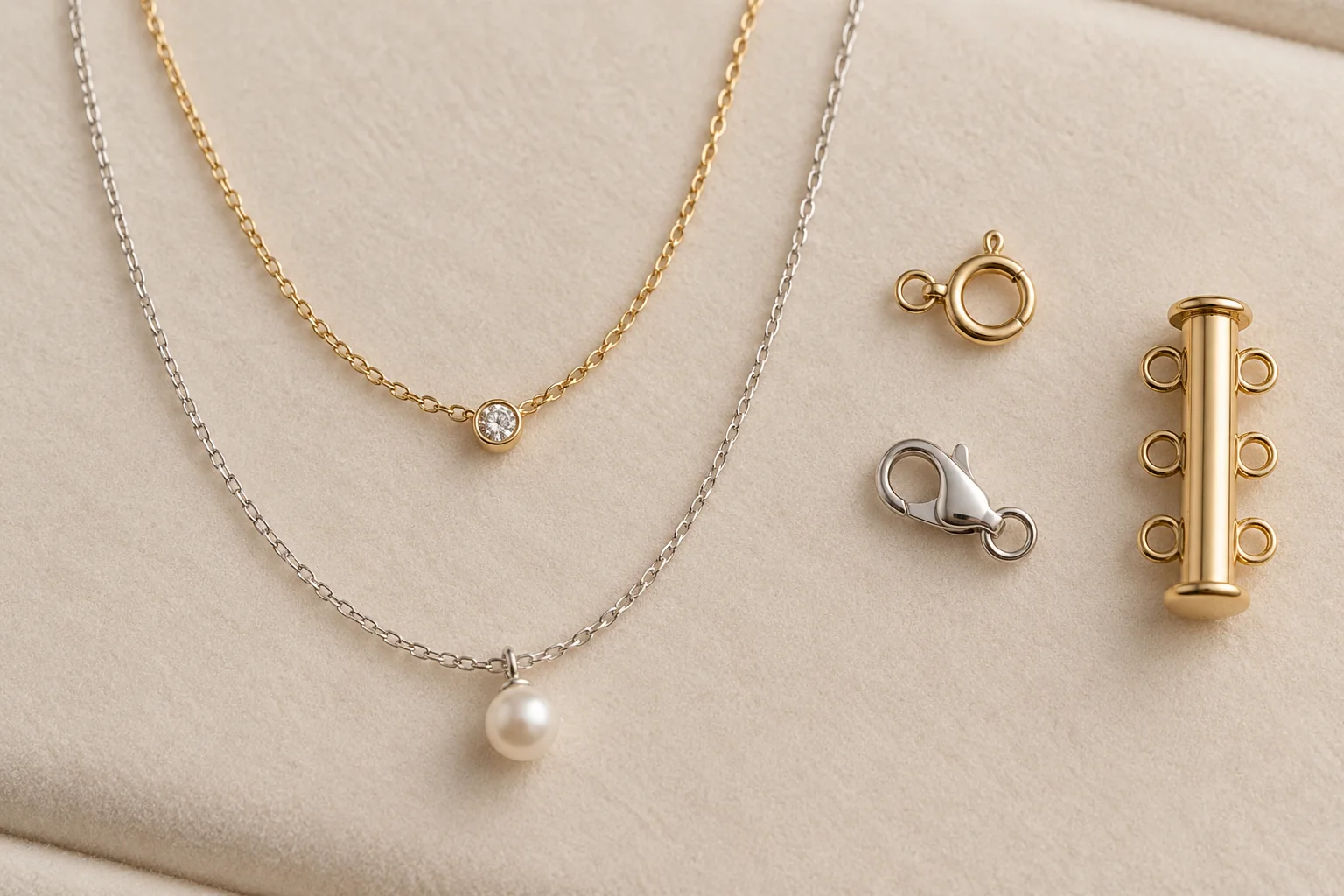
I can buy a necklace spacer and still end up with crossed chains. I want to check the hardware before I add another accessory.
I choose a necklace spacer by checking whether both ends of each chain connect without force. I also check added length, metal information, closure type, and comfort. I treat a spacer as an arrangement tool. I do not expect it to guarantee a tangle-free necklace stack.
At Zolay Nights, I want jewelry advice to make everyday choices easier. I would start with the necklaces already in the stack. I will explain how I would assess a connector before buying it and how I would decide whether it adds useful control or extra trouble.
What can I reasonably expect a necklace spacer to do?
I can mistake a neat product photo for proof that my necklaces will stay still. I need to understand what the connector actually changes.
I expect a necklace spacer to place chain ends at separate attachment points and give me one closure for the group. I still expect movement at the front of my neck. I would check chain length and placement before assuming a connector will solve every crossing.
I identify the problem before the accessory
I would first look at where the trouble starts. I would distinguish crossed clasps at the back from chains that overlap around the pendant. I would also notice whether one necklace keeps turning when I bend forward. I would not treat those three situations as the same problem. I would use the guide to why layered necklaces tangle if I still needed to identify the main cause.
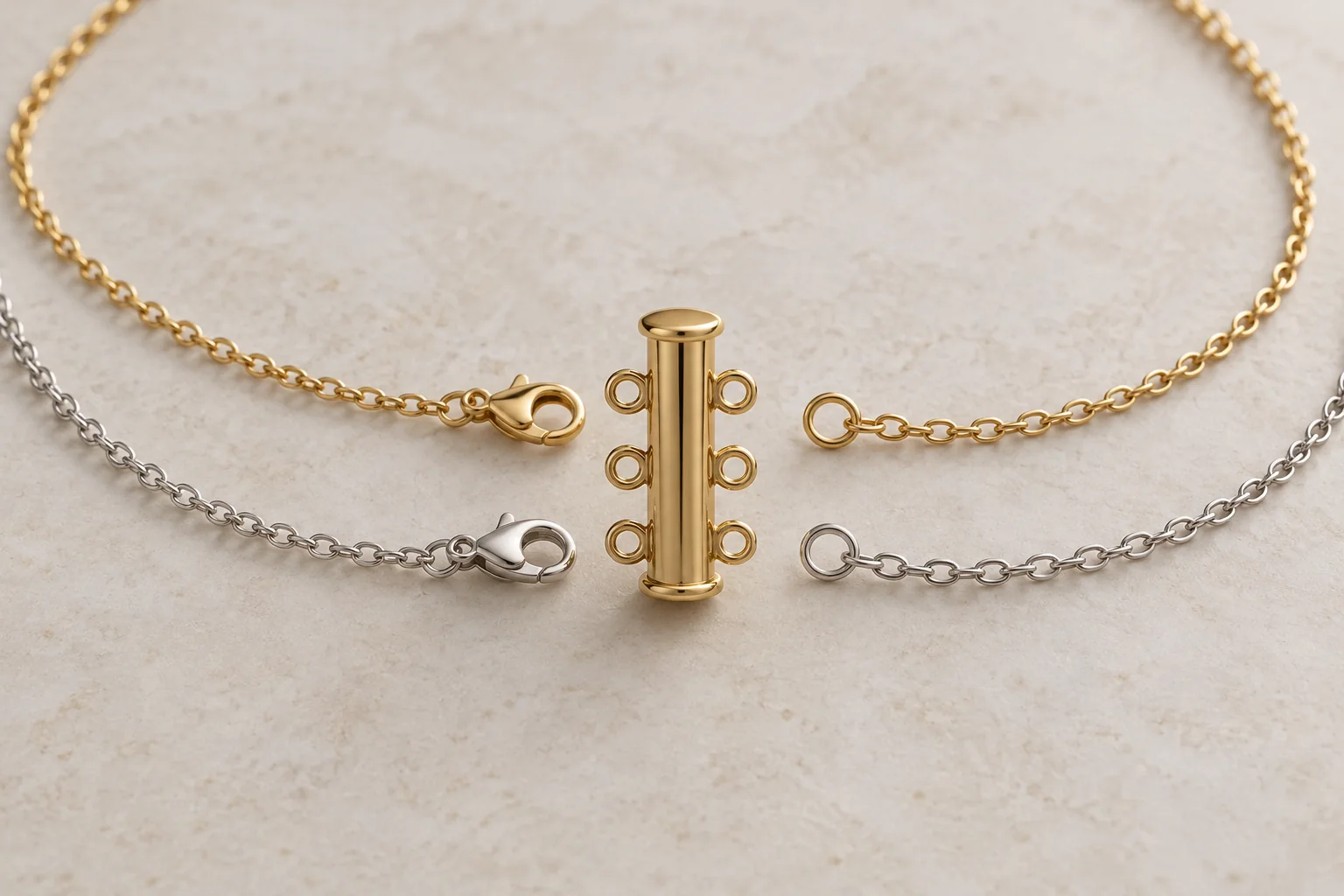
I would then check what the proposed spacer changes. I would look for individual loops or hooks for each strand. I would check whether I can open the group without unclipping every chain. I would read the maker's attachment instructions instead of guessing from a front-facing photo. I would also check whether the item is a complete closure or just a bar that belongs inside a handmade necklace.
| Problem I see | Question I ask about a spacer |
|---|---|
| I find chain ends crowded at the back | I ask whether separate attachment points suit my clasps |
| I see pendants overlap at the front | I check lengths and pendant positions first |
| I dislike opening several tiny clasps | I check how the central closure operates |
| I find one chain uncomfortable | I check that chain on its own before adding hardware |
I would not read a seller's anti-tangle wording as a result I can promise. I would regard a connector as one possible change to the arrangement. I would still keep the stack simple enough to remove easily. I would prefer two comfortable necklaces to three pieces that require constant attention just because the connector has three rows.
How do I check whether my clasps fit the connector?
I can choose the right number of rows and still find that a clasp will not close. I need to check both sides of every necklace.
I check the necklace clasp against the spacer loop and the necklace end ring against the spacer hook. I need each connection to close fully without force. I ask for clear dimensions and attachment photos if the listing does not show the opening and usable space.
I trace one complete connection
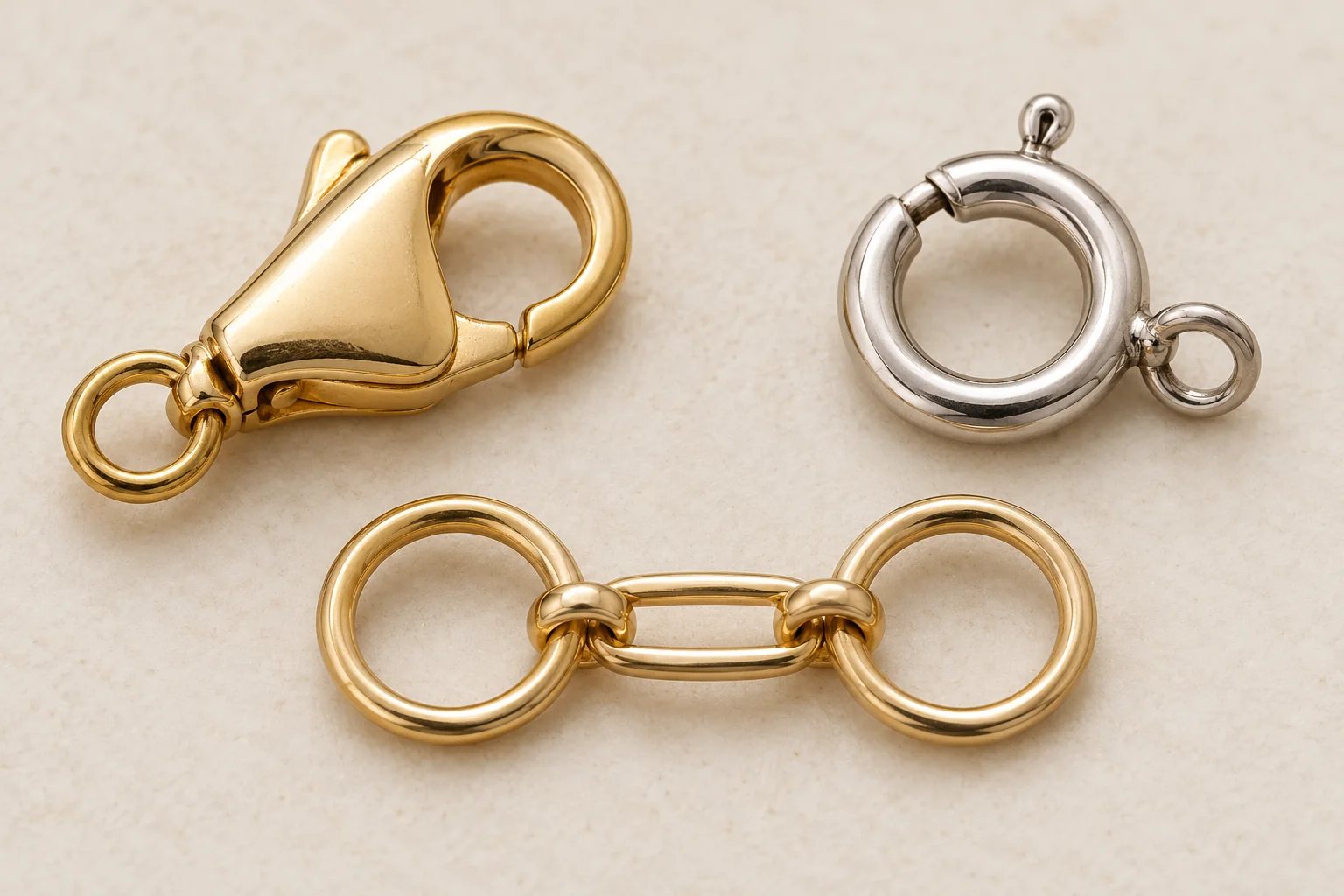
I would lay one necklace on a soft surface and find its clasp and its end ring. I would compare each end with the corresponding part of the connector. I would not check only the necklace clasp. I would also check whether the connector's own clasp can reach and close around the necklace end ring. I would repeat that inspection for each chain because similar-looking necklaces can use different hardware.
I would ask for the usable inner opening of a loop when only its outside size is shown. I would ask whether a hook or spring ring is included on both sides. I would also check whether an extender ends in a ring that the connector can actually use. I would keep the inspection simple. I would not pry open an end ring or bend a clasp to make the pairing fit.
I use the maker's description of the Spartina layered clasp as an example of a product that identifies its three spring ring clasps.1 I do not turn that description into a claim that all spacers use the same hardware.
I would ask a jeweler for help if a valuable or delicate necklace needs a different end fitting. I would not make a permanent change as a casual home fix. I would also check whether the chain is already attached to a shared closure. I would not assume that an integrated multi-strand necklace can be treated as several removable necklaces. I want each connection to be clear and reversible before I consider the connector practical for regular use.
How do I account for the length the spacer adds?
I can like a stack before adding a connector and dislike where it sits afterward. I want to check the complete arrangement before judging the look.
I include the connector in the total path around my neck. I compare the finished position of every pendant and check any extender setting. I use length differences as a starting point for separation, then judge the actual fit. I do not rely on one fixed gap for everyone.
I compare finished positions rather than labels
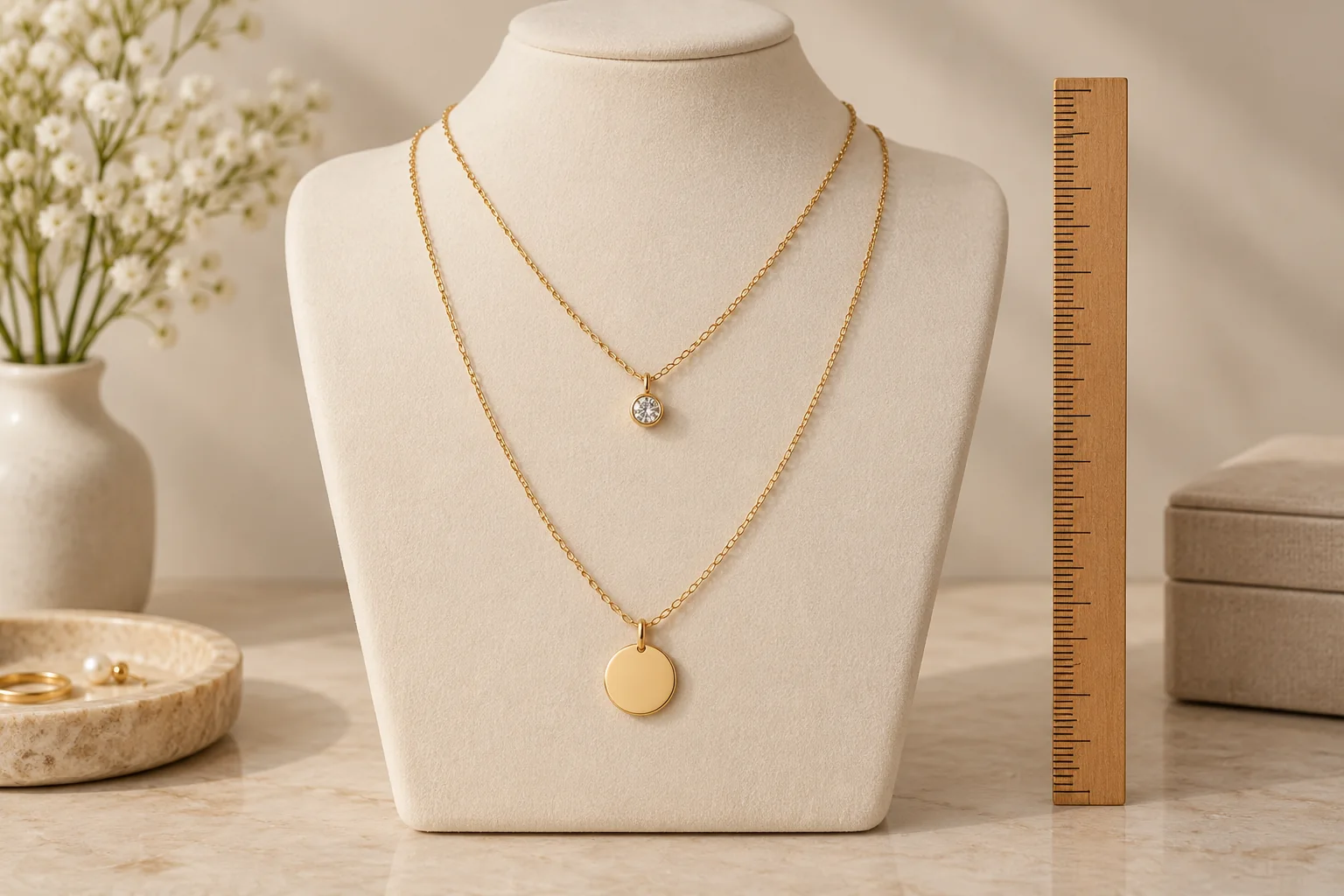
I would first note where each necklace sits without the connector. I would then check the connector's stated dimensions and the way each attachment point lines up. I would not assume that a small bar adds no noticeable length. I would also avoid a rough calculation that ignores the hooks and end rings. I would judge the assembled result on my neck before deciding that the original size labels still describe the fit.
I would check the stack with the clothing I expect to wear. I would look at whether a pendant meets the neckline or rests on a seam. I would also notice whether the upper chain feels more like a close collar than I intended. I would move an existing extender setting before buying more hardware if that simple change gave the pieces enough separation.
| What I record | How I use the note |
|---|---|
| I note each pendant's starting position | I compare it with the connected arrangement |
| I note the extender setting | I can repeat the fit without guessing |
| I note the neckline I plan to wear | I check whether the pendant has room to sit |
| I note which rows I use | I can restore the same attachment order |
I use the necklace length guide when I need a starting reference. I still treat those lengths as options rather than a promise of where a necklace will land on every body. I would try fewer strands if the finished stack remained crowded. I would not keep adjusting a connector when the necklaces themselves no longer matched the look or comfort I wanted.
How do I judge the closure, metal, and feel at the back?
I can focus on the front of a necklace stack and overlook the connector against my neck. I want to check that part before regular wear.
I read the connector's metal description, inspect the closure, and check the edges and moving parts. I confirm that the closure shuts fully. I stop if it catches my hair, feels sharp, or irritates my skin. I do not infer material from a gold or silver color.
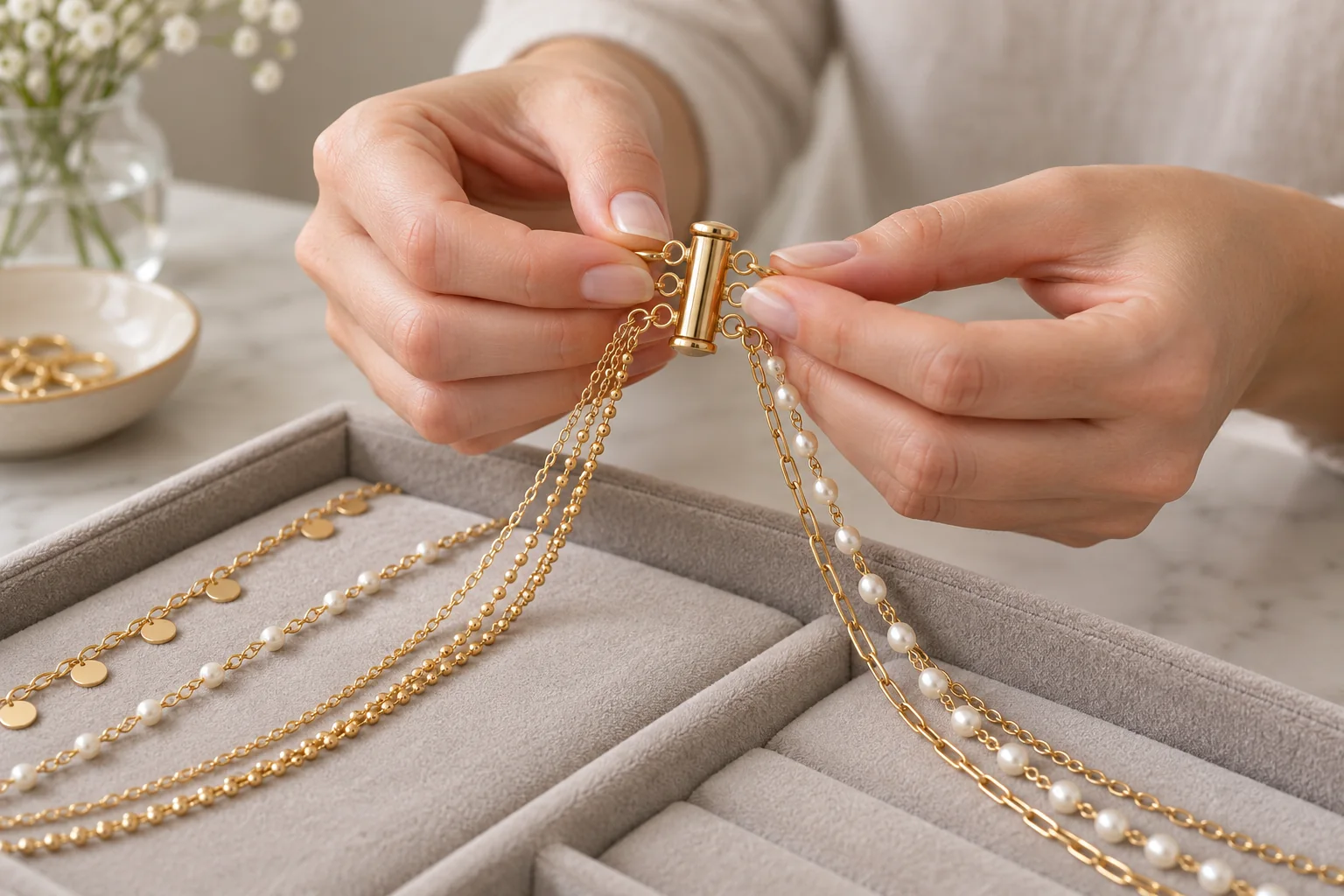
I read material and color as separate details
I would look for the base metal and any stated surface finish. I would not read gold-tone as solid gold. I would also avoid treating silver color as proof of sterling silver. I would ask for the missing material information before deciding whether the connector suits my needs. I would not repeat an allergy-safe claim unless the seller provided clear support for that specific product.
I would check the closure above a soft tray. I would open and close it using the maker's instructions. I would watch whether the halves sit together cleanly and whether the latch returns to its closed position. I would not pull hard on a fine chain to test the strength of a connector. I would ask a jeweler to inspect a closure that looked bent or failed to close properly.
I would also check the placement with my hair and usual clothing. I would notice whether a hook faces outward or whether an edge catches a collar. I would not keep using hardware that repeatedly snags. I would remove the stack if I felt irritation rather than covering the connector with an improvised coating.
I follow the GIA's jewelry care guidance when I consider cleaning and storage.2 I do not assume that every metal finish or gemstone can share the same cleaning method. I would remove the stack before bed and keep the connector with its own care details. I would choose a simpler closure if I found the extra parts more awkward than the original clasps.
How do I decide whether the spacer is worth keeping?
I can keep adjusting an accessory because I already bought it. I want a clear way to judge whether it helps my actual routine.
I compare the same small necklace stack with and without the spacer during a short, ordinary wear check. I note comfort, ease of removal, hair catching, and chain position. I keep the connector only if it makes the arrangement easier for me. I do not call this a controlled test.

I decide what useful means before the check
I would choose two necklaces first. I would avoid adding a third simply because the connector has spare rows. I would decide what I wanted to improve. I might want less crowding at the back or an easier way to remove both pieces. I would not use a vague hope that the stack would somehow feel better as my only criterion.
I would keep the clothing and extender settings as similar as possible during the comparison. I would note ordinary movement rather than tugging the chains or trying to force a knot. I would look in a mirror after sitting, standing, and bending in normal ways. I would remove the stack promptly if a connection opened or a chain caught in my hair.
| Question I use | Decision it helps me make |
|---|---|
| I can remove the group without pulling | I may find the shared closure useful |
| I keep checking for a snag | I may prefer the separate original clasps |
| I still see crowded pendants | I may need a different pair of necklaces |
| I find no useful change | I do not need to keep adding accessories |
I would record the observation as a personal fit check. I would not turn it into a general percentage reduction in tangling. I would detach and store the pieces carefully afterward. I use the necklace travel storage guide when I need to pack the pieces separately. I would keep a connector that genuinely simplified my routine. I would stop using one that introduced more catching, uncertainty, or work than it solved.
Conclusion
I check both chain ends, finished length, and closure comfort before choosing a spacer. I keep it only when the small stack becomes easier to wear and remove.
- I cite the maker for the described clasp construction. I do not treat seller wording as independent proof of tangle prevention or compatibility with every chain. ↩
- I use GIA for general jewelry handling and storage. I still follow the care instructions for the actual metals, finishes, and stones in my pieces. ↩
Images are AI-generated editorial illustrations. They do not identify or verify a specific product.