
How Do I Adjust a Y Necklace for My Neckline?
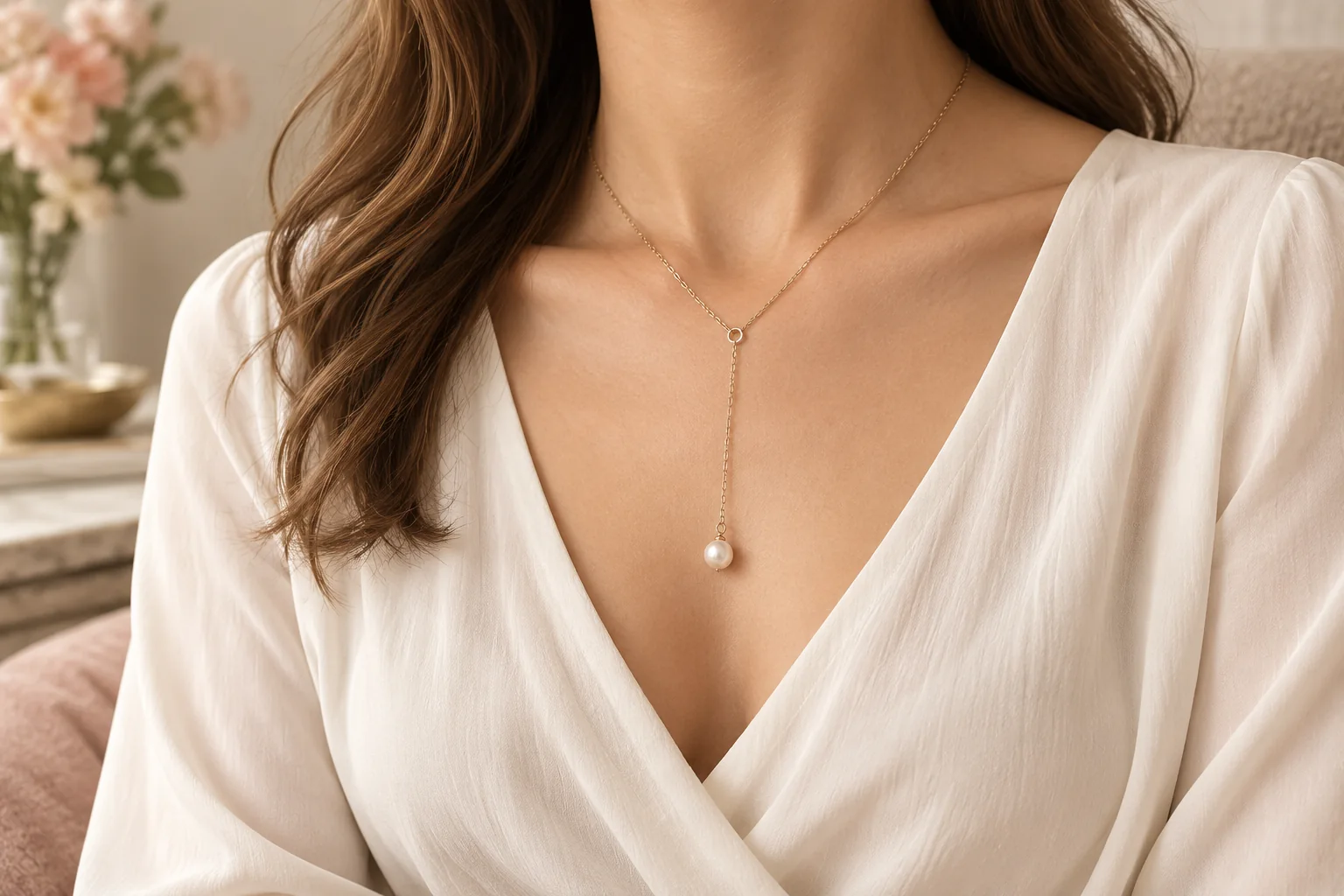
I can like a Y necklace in the box and dislike its position on a shirt. A drop that meets the neckline edge can keep disappearing or catching.
I adjust a Y necklace by checking three positions: the neck loop, the Y junction, and the hanging drop. I move only the adjustment parts designed for that necklace, compare the result with my actual neckline, and check comfort during ordinary movement before adding another chain.
At Zolay Nights, I treat the Y shape as a different styling problem from a simple pendant length. The visible tail adds another resting point. I use the verified sliding design of our Pearl Drop Adjustable Y Necklace as one example, while keeping the instructions for each individual necklace in charge.
Which parts of a Y necklace do I check before adjusting it?
I can move the wrong part when I think every Y necklace works alike. A fixed junction or an unfamiliar closure can turn a styling change into damage.
I identify the neck loop, junction, hanging tail, and actual adjustment mechanism before moving anything. I check whether the junction slides or stays fixed. I read the product instructions because the words Y necklace and lariat do not guarantee the same construction.
I separate the shape from the mechanism
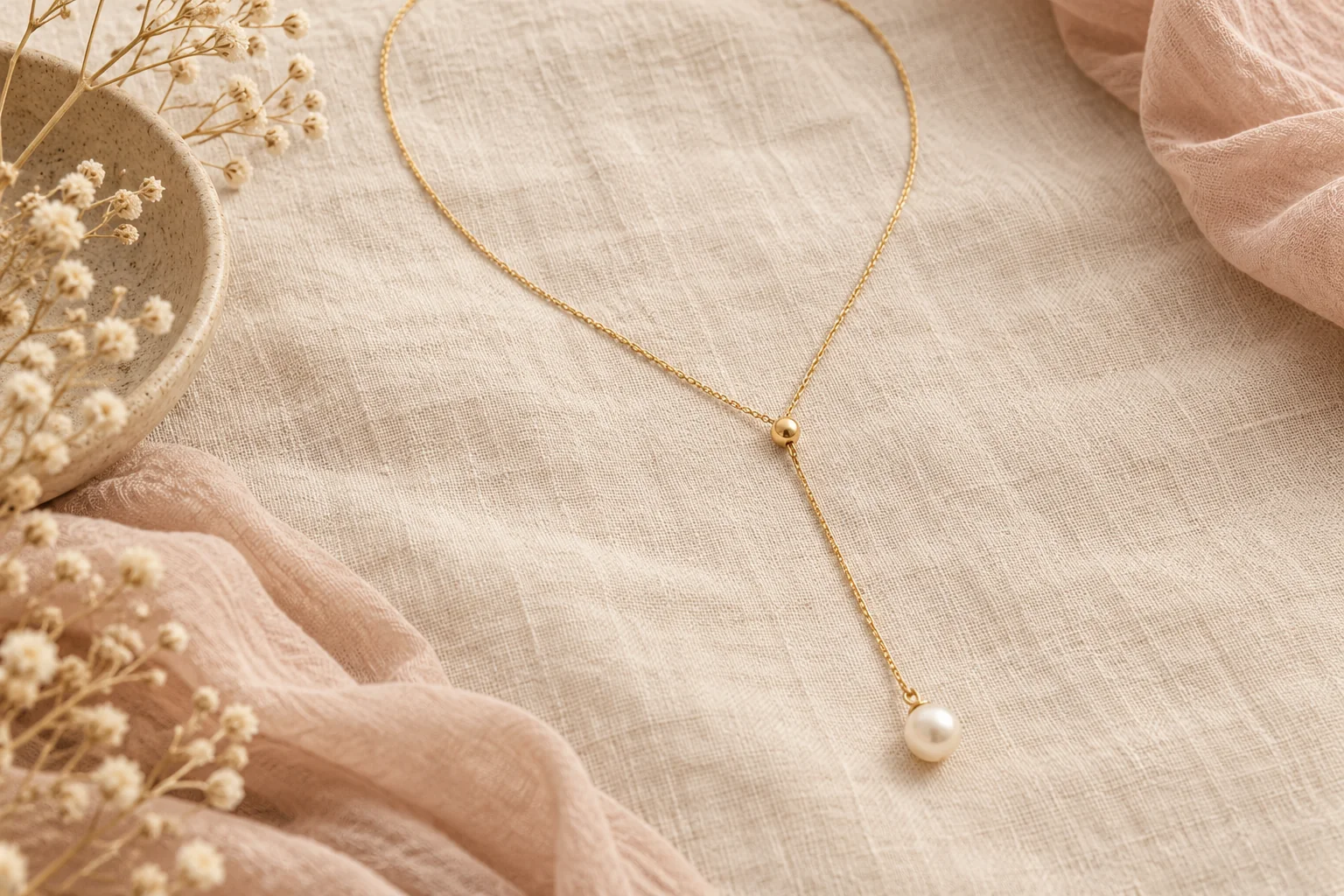
I lay the necklace flat on a clear, soft surface so I can see how it is made. I trace the loop first. I then find the point where the shape becomes a tail. I look for the part that the seller identifies as adjustable. A chain may have a rear extender, a front slider, or another arrangement. I do not assume that the front decoration is a slider just because it looks like a small bead.
For our Pearl Drop Adjustable Y Necklace, the current description identifies a snake chain, a sliding bead, and a glass pearl accent. I use those details when discussing that item. I do not call the glass accent a cultured pearl, and I do not infer a solid-gold metal from a gold-tone finish.
| My part to inspect | My question | My next step |
|---|---|---|
| I trace the neck loop | I ask how it closes | I check the stated closure |
| I find the Y junction | I ask whether it moves | I identify the designed adjuster |
| I follow the hanging tail | I ask where it will rest | I compare it with the outfit |
I also check the chain for an obvious kink or a caught section before adjusting it. I do not use the slider to pull a kink straight. If the mechanism is unclear, I ask the seller for instructions that match the exact item. A simple description of the intended movement is more useful than copying a video of another necklace with a similar shape.
How do I move a sliding junction without pulling the chain?
I can tug the tail to make a quick change while the necklace is on. That shortcut gives me less control and can put unnecessary force on the chain.
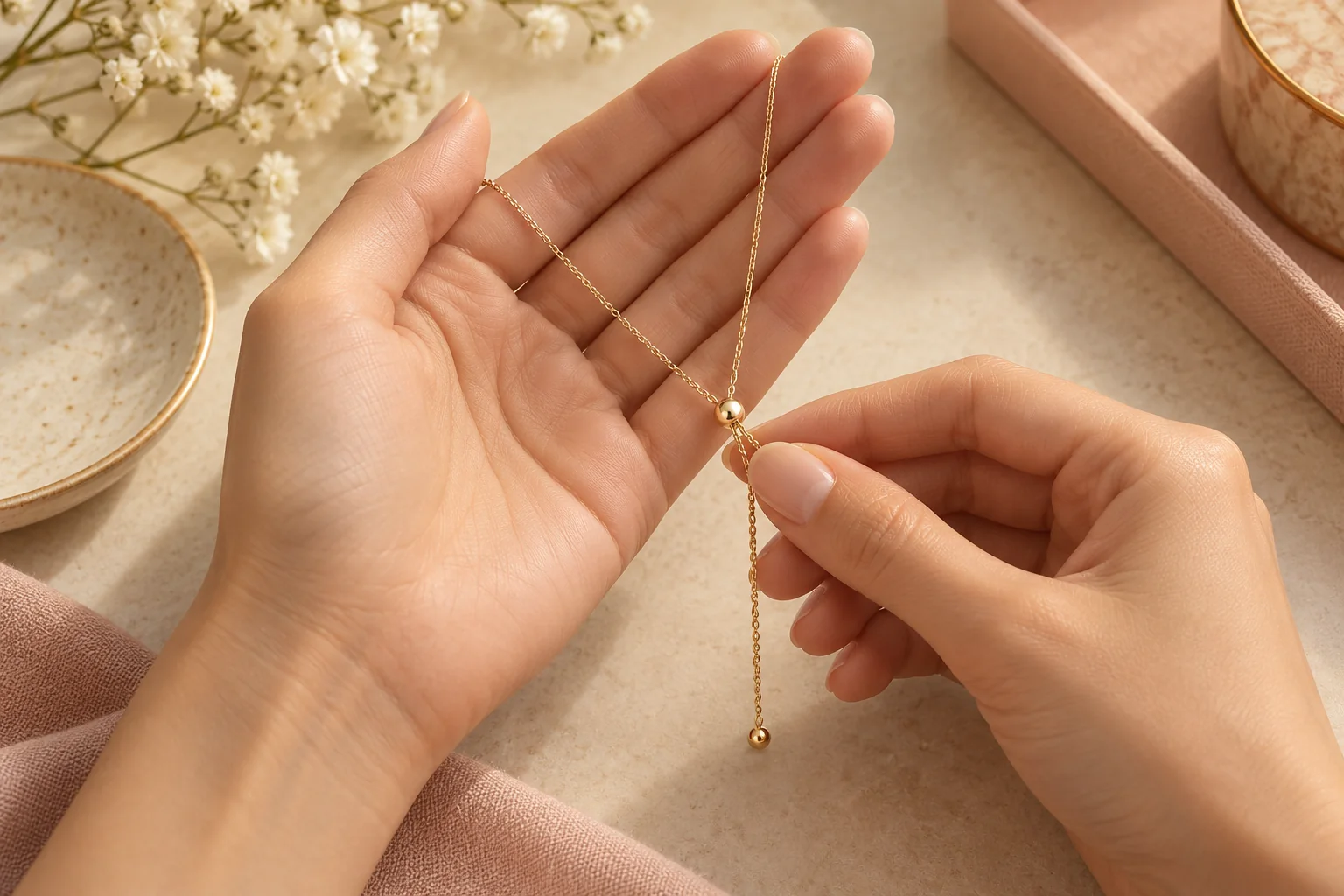
I support the chain and follow the maker's adjustment instructions in small movements. I keep the necklace away from tension against my neck. I stop if the slider catches or needs force, and I never assume a fixed junction should move.
I make one small change at a time
I first establish how the maker wants the piece handled. I do not offer one hand motion for every slider. Some designs have different internal grips or moving parts. With the Zolay design, the current care guidance specifically warns against pulling the drop through the slider abruptly. I treat that warning as the starting limit for an adjustment.
I take the necklace off if I cannot control the movement comfortably while wearing it. I support the parts on a clean surface and avoid letting the decorative end hang from my fingers. I work slowly, with enough light to see whether the chain is moving evenly. My aim is a change in position, not a test of how much force the piece can take.
I check the result after each small change. A movement at the junction can alter the visible relationship between the upper loop and the lower tail. I do not assume that a longer-looking drop leaves every other position unchanged. I try the necklace with the garment again before making a second adjustment.
If the slider feels stuck, I stop. I do not add oil, soap, lotion, or a household lubricant. I also do not use pliers to make a styling adjustment. Those actions could create a new care problem and are not part of the verified instructions.
I keep a note of a useful resting position in ordinary words, such as below the neckline on the plain panel. I avoid treating that position as a permanent measurement. Another outfit may need a different proportion, and a different necklace may need a different method.
How do I choose a drop position for a V-neck or high neckline?
I can judge a necklace in front of a mirror without wearing the final top. Then the neckline changes the picture, and the drop loses the place I intended.
I try the Y necklace with the actual garment and choose a clear resting area for the junction and drop. I compare exposed skin, plain fabric, and neckline edges. I use my own preference and the garment's movement, rather than a universal length rule.
I use the garment as the reference
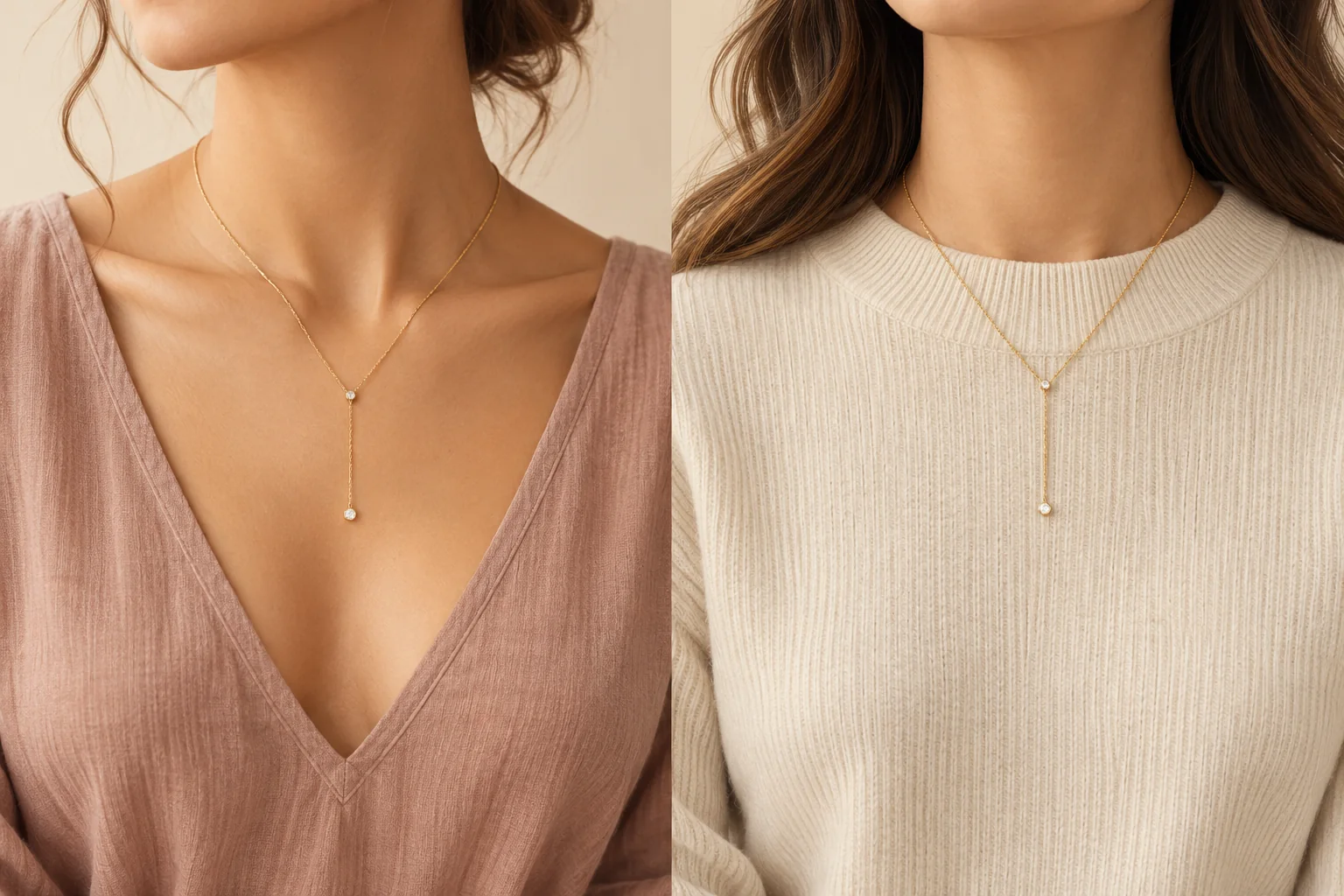
I put on the top before deciding where the tail should finish. I look at the neckline in its normal position rather than stretching the garment into a different shape. I then ask whether I want the jewelry to sit inside the opening or over the fabric. Either arrangement can be a starting point, but I need to see the actual result.
For a V-neck, I check the space between the junction and the fabric edge. I may prefer a short visible tail inside the opening, or a longer line that reaches the garment. I do not claim that one option suits every body or every V shape. A narrow opening and a wide opening can produce different resting points.
For a high neckline, I check the plain area below the collar. A fine chain may become less visible against a busy print or textured knit. I can choose a quieter top, accept a subtle effect, or use another piece. I do not need to add more jewelry just because the first necklace is hard to see.
| My garment detail | My visual check | My adjustment to consider |
|---|---|---|
| I have an open V | I see where the edge meets the tail | I try a clearer gap |
| I have a high plain collar | I see the drop against fabric | I compare its resting point |
| I have buttons or a zip | I check nearby hardware | I choose a position away from it |
I use the separate necklace-length guide when I need to assess the whole loop. Here, I keep my attention on the extra junction and tail, because those are the parts that make the Y shape behave differently from a single pendant.
How do I test whether the drop works when I move or layer it?
I can create a neat Y shape while standing still and spend the day moving it back. A second necklace may also take the space that the tail needs.
I test the Y necklace on its own while sitting, turning, and bending gently. I check for catching, uncomfortable tension, and repeated repositioning. If I add a second necklace, I compare its resting point with the junction and leave room for both pieces to move.

I check the outfit in ordinary positions
I sit down in the top that I plan to wear. I turn my head and shift my shoulders normally. I then check whether the drop remains in a useful place or catches at the neckline. I do not pull it into position during every movement and then call the outfit easy to wear. Repeated adjustment is part of the result I am assessing.
I pay attention to nearby objects. A button, zipper pull, scarf, or bag strap may meet the tail when I change position. I do not claim that a Y necklace is suitable for every activity. If the drop keeps catching in an outfit, I choose another position or another accessory. I take jewelry off before activities where it could become caught.
I add a second necklace only after the first works alone. I compare the second pendant or chain with the Y junction. Two details resting on the same line may compete visually or touch during movement. I use Kendra Scott's necklace-layering guide for styling ideas about a base piece and balanced spacing.1 Those ideas are optional, not rules for every outfit.
I also check the back of the neck. A front adjustment does not tell me whether two closures are sitting comfortably together. I keep the whole arrangement in view, especially when an extender changes the resting point.
My layering guide explains the broader choice of focal piece and chain length. I use this Y-necklace test for a narrower question: whether the junction and free tail still work when the outfit moves around them.
How do I care for the chain and keep its shape between wears?
I can get the drop into a good position and then put the necklace in a crowded drawer. A tangled or bent chain makes the next adjustment harder.
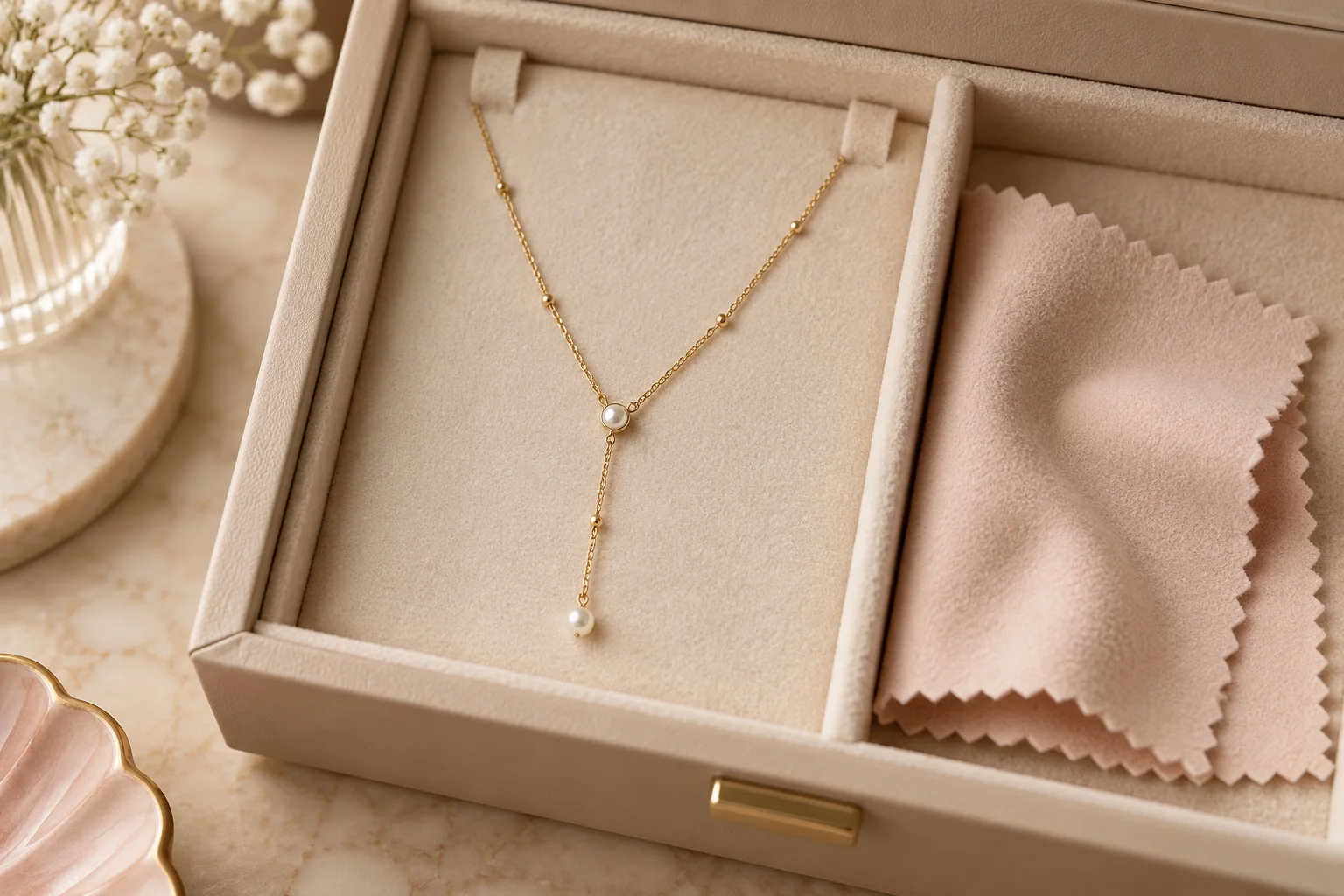
I follow the exact item's care guidance, handle the slider gently, and store the necklace flat and separately. I avoid folding the chain sharply or placing other jewelry on the drop. I inspect the piece before adjusting it again.
I keep styling and cleaning separate
I do not use cleaning as a way to make a reluctant slider move. If the adjuster needs attention, I ask for guidance that matches the item. A cleaner that is suitable for one metal or gemstone may not be suitable for a coated chain or decorative accent. The word pearl in a product name is not enough to choose a cleaning method.
The GIA jewelry-care guidance explains that materials can need different care and that jewelry should be stored with protection from contact with other pieces.2 I use those general principles alongside the item's instructions. I do not apply natural-pearl cleaning advice to Zolay's glass pearl accent as if they were the same material.
For this Zolay Y design, the stated care is gentle wiping after wear, flat separate storage, and avoiding abrupt pulling through the slider. The page also warns against abrasive cleaners, perfume, lotion, and prolonged moisture. I follow those instructions without adding an unsupported waterproof or tarnish-free claim.
| My handling moment | My care choice |
|---|---|
| I take the necklace off | I support the tail rather than tug it |
| I put it away | I lay the chain flat and separate |
| I prepare the next outfit | I inspect before moving the slider |
| I find damage or sticking | I stop and ask for item-specific help |
I leave the necklace relaxed in its own space. I do not create a tight coil just to fit it into a smaller pouch. I also keep it away from damp textiles and open cosmetic containers. When I take it out again, I can see the chain clearly and make a small styling change without first untangling several pieces.
Conclusion
I find a useful Y-necklace position by checking its mechanism, matching its junction and drop to the outfit, and testing movement with gentle handling.
- I use Kendra Scott's guide for optional styling ideas, not a guaranteed fit or tangle-free result. ↩
- I use GIA for general material-aware care and separate storage; the exact item's instructions still govern its cleaning and adjustment. ↩
Images are AI-generated editorial illustrations. They do not identify or verify a specific product.