
Can I Iron or Steam the Wrinkles in My Silk Bonnet?
I can see a crease in my bonnet and reach for the iron's silk setting. That shortcut overlooks the finished opening, seams and other components.
I iron or steam a silk bonnet only when the maker's instructions support that treatment for the complete item. I do not use a silk setting as permission. I first inspect the folds, follow permitted gentle reshaping and drying, and ask for guidance if a stubborn crease still concerns me.
I write the Zolay Nights Journal to help with everyday care choices. This guide focuses on wrinkles and heat, rather than the full washing routine. I want to understand which marks need attention and which treatment the actual bonnet permits before I try to make it look smoother.
Am I looking at a loose fold, a seam or possible damage?
I can treat every line as a wrinkle and try to flatten it. A gathered opening or seam may be part of the shape I should preserve.
I inspect the bonnet dry and relaxed in good light. I distinguish loose fabric folds from intended gathering, seams, pulls and tears. I do not press the opening flat or pull a crease apart to identify it. I ask about a mark that changes the fabric or affects comfort.
I look before I choose a treatment
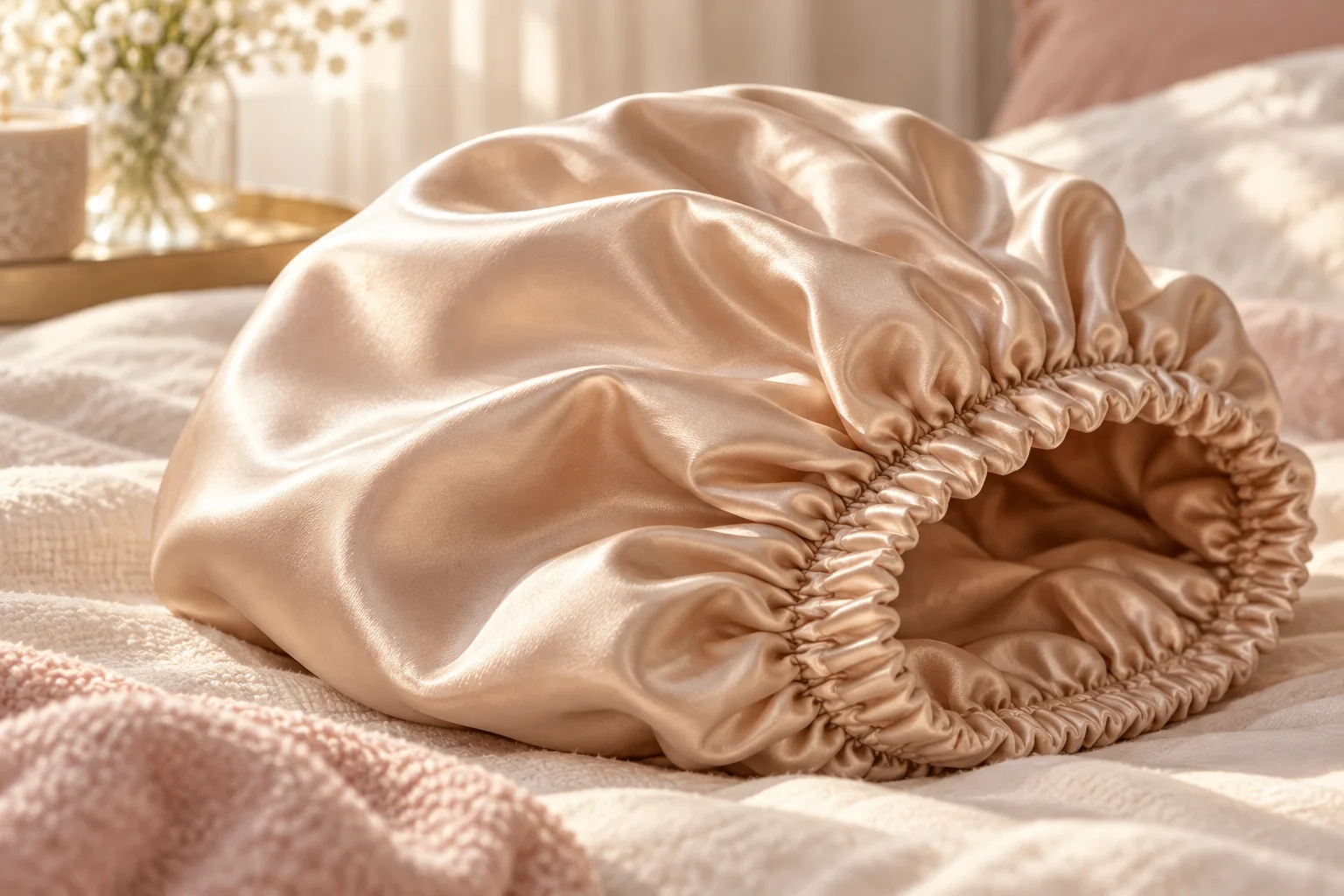
I place the bonnet on a clean surface. I open the crown gently enough to see its shape without stretching the edge. I check whether the line follows a seam or appears where the fabric was folded in storage. I do not pull both sides in opposite directions to make the line disappear.
I notice how the mark looks in ordinary light. A loose fold may change as I reposition the fabric. A seam follows the construction. A pulled thread, hole or rough area gives me another kind of question. I describe what I see without claiming that a photograph can diagnose the fiber or prove that heat will solve the issue.
| Detail I see | Question I ask |
|---|---|
| Soft folds in the crown | I ask whether they affect use or only appearance |
| Regular gathering at the edge | I ask whether it belongs to the opening's design |
| A pull, tear or rough patch | I ask for guidance before treating it |
I keep a small visual crease separate from an uncomfortable fit. If the opening presses because it has folded under itself, I inspect the edge's intended position. I do not apply an iron to make that position fit better. I also do not assume that a completely flat bonnet would be more comfortable. A gathered crown needs room and shape.
I allow a bonnet to look like an item I use. I do not need every soft fold removed before the next wear. If I see damage or feel a rough area, I set it aside and ask about that specific concern. I do not turn a cosmetic goal into an experiment on a component I cannot identify.
Why does the iron's silk setting not answer the question?
I can read the fiber name and overlook the label's treatment limits. A bonnet can combine parts that do not share one simple care method.
I use the finished item's care directions to decide about ironing or steaming. GINETEX says an ironing limit comes from the care label, rather than fiber content alone. I check the bonnet's opening, lining, ties and hardware as well as its silk crown before considering heat.

I ask about the complete construction
I read any care label and the current product description together. I look for an explicit ironing or steaming instruction. I do not treat silence as permission. If I cannot find a clear answer, I ask the maker whether either treatment is allowed and what limits apply to the finished item.
GINETEX's care-symbol explanation separates ironing conditions from the fiber name.1 I use that distinction because an appliance setting cannot know the construction in front of me. I do not copy a temperature from a general chart onto an item whose label does not authorize ironing. I also do not treat low heat and no steam as interchangeable with a steam treatment.
I inspect the other parts listed for my bonnet. I may have a gathered elastic edge, broad ribbons, knit ties or adjustment hardware. The current Zolay Nights bonnet care descriptions explain washing, reshaping and air drying. They do not establish a general home-ironing or steaming procedure. I therefore leave heat out unless I receive suitable item-specific instructions.
I use the silk-care page as a starting point, then check the exact product. A silk scarf, a lined dress and a bonnet are different finished objects. Advice for one does not automatically cover the others. I do not use a pressing cloth, a bathroom full of steam or a hidden-area trial to bypass a missing instruction. A trial can still change the fabric or other parts. I want a supported method before I apply a treatment, rather than rely on the appliance's reassuring name.
What gentle shaping can I do during permitted care?
I can let a bonnet dry as a tight bundle and then want heat to fix its shape. The care process gives me a better point to check its arrangement.
I follow the maker's permitted washing and drying method, then arrange the bonnet gently without stretching its opening. I avoid wringing, twisting or pressing it under weight. I do not wash it repeatedly just to chase wrinkles, and I do not promise that gentle reshaping removes every crease.
I arrange the shape without forcing it
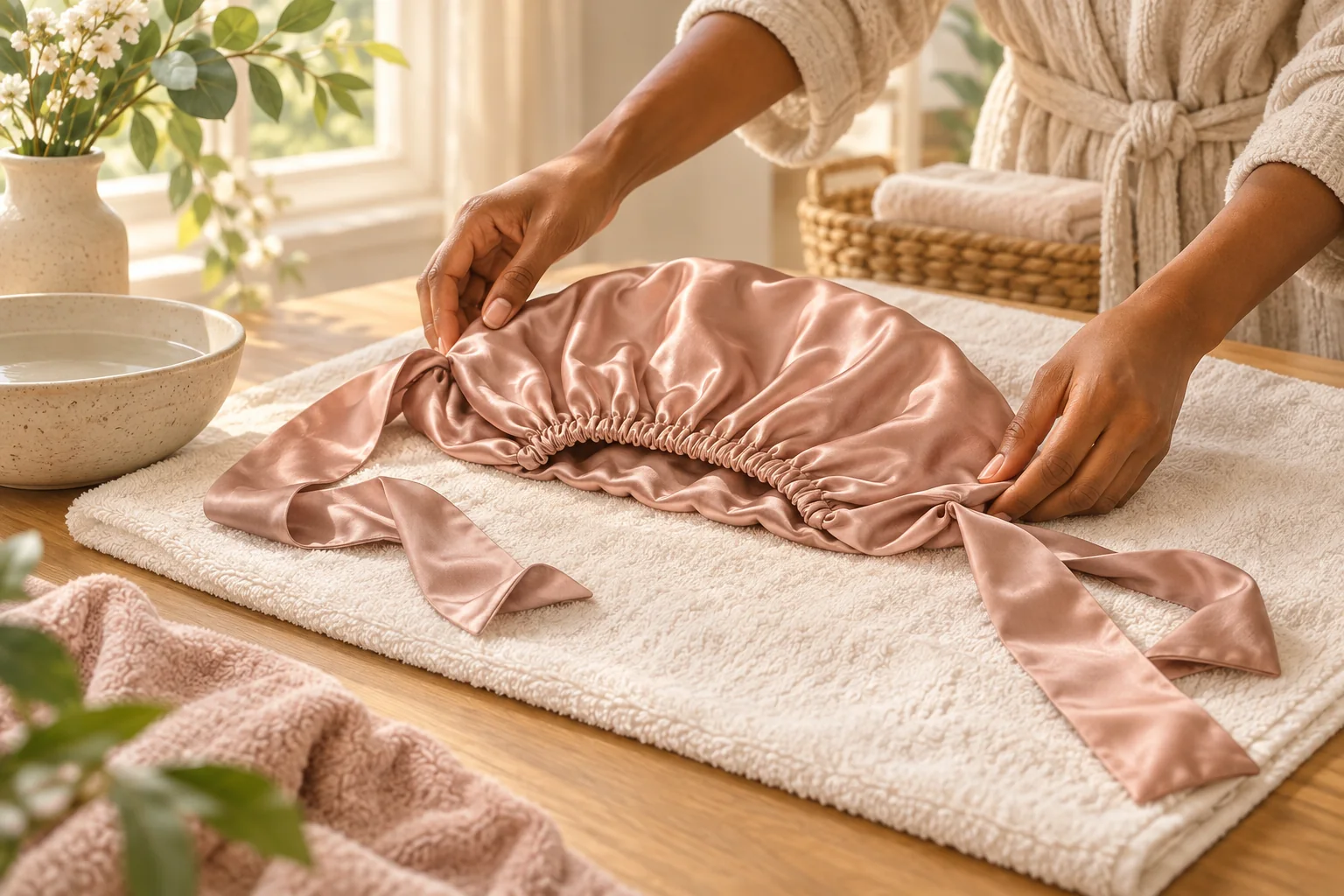
I clean the bonnet when cleaning is needed, using its stated method. I do not add a wash solely because I dislike a small fold. If the item is already in a permitted wash routine, I use the drying stage to notice whether the crown is bunched and whether the ties are twisted. I reshape only as the instructions allow.
For current Zolay Nights bonnets, I check the exact description for gentle hand washing in cool water, silk-safe detergent and drying away from direct sunlight. Several descriptions also say not to wring and to reshape gently. I keep the opening supported rather than use it as a handle for the wet crown. I do not pull the bonnet across a rigid form to make it smooth.
| During permitted care | Action I choose |
|---|---|
| The crown is bunched | I arrange it gently without pulling the edge |
| The ribbons are twisted | I lay them loosely according to the care instructions |
| The fabric remains creased | I let it finish drying and reassess before doing more |
I use the washing and drying guide for the wider sequence. I do not replace its item-specific approach with a wrinkle-removal recipe. I also do not use a hair dryer, radiator or hot iron to shorten the drying time. I let the item become fully dry before I store it or judge its finished shape.
I accept the limits of gentle shaping. I can arrange a fold more sensibly without claiming that I restored the fabric. If the crease stays visible, I decide whether it matters for use. I ask for guidance when a mark affects the surface or the opening rather than repeat a stronger treatment.
How do I store the bonnet without packing in sharper folds?
I can smooth the bonnet and place it under several heavy items. A crowded drawer can work against the careful handling I just chose.
I store my bonnet clean, fully dry and loosely arranged in enough space for its shape. I avoid sharp compression, heavy objects and a tightly stretched opening. I choose a gentle fold or placement that suits the item, rather than promise storage will make an existing crease disappear.

I give the finished shape somewhere to rest
I choose a clean compartment or shelf with enough room for the bonnet. I do not push it into the smallest gap between other items. I keep jewelry, rough fastenings and open cosmetics separate. I want to remove the bonnet without catching its fabric on another object or pulling it out by the edge.
I use a loose arrangement that respects the crown and closure. I do not press the gathered opening flat to make a more compact package. I place broad ribbons without a tight twist. If the item needs folding, I avoid squeezing the same narrow line under a heavy stack. I do not tie the ribbons around the folded crown as a storage fastening.
The Canadian Conservation Institute discusses support and creasing in textile collections.2 I use that as general background on careful textile handling. Its guidance concerns museum objects, so I do not borrow a museum treatment, humidity target or cleaning procedure for my modern bonnet. The product's care instructions still decide the practical routine.
I check that both the item and the storage surface are dry. I do not close a damp bonnet in a pouch to make its surface look neater. I also do not hang it from an elastic opening if that leaves the crown's weight pulling on the band. I choose a supported placement allowed by its care guidance.
I can make the storage step small. I do not need archival materials or a new organizer to answer this everyday question. I need enough space and a place that does not compress the bonnet under other objects. I check the result when I next take it out and adjust the arrangement if I see an avoidable sharp fold.
What do I ask if the crease still needs attention?
I can try several internet fixes before asking the maker. That makes it harder to describe the original mark and the treatments it has already received.
I send the maker a clear description of the crease, the exact product and its care history. I ask whether ironing, steaming or another treatment is supported for the complete bonnet. I keep the item unchanged while I wait and do not assume a professional cleaner can use every method.

I make the question specific enough to answer
I take one photo of the whole bonnet and one of the area that concerns me. I use ordinary light and do not alter the color or sharpen the image to exaggerate the line. I mention whether the mark appeared after delivery, storage or a wash. I state any treatment I have already used honestly.
I identify the product and closure. A question about a silk bonnet with a gathered edge is clearer than a question about silk in general. I ask whether the proposed method covers the crown, the opening and any lining or hardware. If the answer gives an ironing condition but says nothing about a steamer, I ask about steam separately.
| Detail I provide | Why I provide it |
|---|---|
| Exact product and closure | I help identify the complete construction |
| Clear photos and location | I show the mark without forcing the fabric |
| Care history | I describe the treatments the item has received |
I ask whether leaving the crease alone is reasonable if it affects only appearance. I do not assume that a smooth photograph represents the only acceptable look after ordinary use. I also do not promise myself that a cleaner can remove every mark without changing the item. I seek suitable advice before arranging a service.
I check the Materials & Care overview when I need to reconnect the care question with material details. I keep the decision focused on this finished bonnet. I can decline an unsupported treatment and still care for the item thoughtfully. I do not need to make a general rule that all silk can be steamed or that all silk must never be ironed.
Conclusion
I judge wrinkles through the finished bonnet's instructions. I handle its shape gently, store it without compression, and ask about heat before applying a treatment.
- GINETEX: Care symbols. I use its distinction between care-label instructions and fiber content when judging heat treatments. ↩
- Canadian Conservation Institute: Caring for textiles and costumes. I use its support and creasing discussion as general context, not a bonnet treatment recipe. ↩
Images are AI-generated editorial illustrations. They do not identify or verify a specific product.