
Can I Clean a Mixed-Material Necklace All at Once?
I can see a dull necklace and reach for one cleaner. A chain, finish and decorative accent may not share the same care limits.
I clean a mixed-material necklace only by a method the maker approves for the finished piece. I identify its parts and check the care instructions first. I do not assume that a cleaner suitable for one metal, stone or pearl is suitable for the complete necklace.
I write the Zolay Nights Journal to help make accessory care more specific. Here I focus on one necklace with more than one material or finish. I separate routine handling from stain treatment and repair, because those tasks need different information.
What parts of the necklace should I identify first?
I can remember the chain's metal and forget a bead, coating or connector. The full item needs more information than its main material name.
I identify the chain base, finish, accent and fastening parts from the actual product description. I keep unknown details marked as unknown. I do not identify a stone, pearl type, treatment or joining method from appearance alone.
I make a short parts record
I start with the product name and selected option. I then copy the stated materials into a small record. I keep the chain base separate from its visible finish. I also distinguish a decorative accent from the setting that holds it. I avoid replacing the seller's exact description with a broader phrase that drops useful detail.
I read the Pearl Drop Adjustable Y Necklace as a finished item with a glass pearl accent and an adjustable sliding design. I do not describe that accent as a cultured pearl, or assume that a guide for cultured pearls establishes its coating or assembly. I follow the care information for the actual necklace.
| Part I record | Detail I want to preserve |
|---|---|
| I identify the chain | I keep base and finish separate |
| I identify the accent | I retain glass, stone or other stated wording |
| I identify moving parts | I note the intended slider or clasp method |
I keep option-specific information with the record. A necklace offered with two stone choices does not become one undifferentiated material. I check which option I own before asking about a cleaner. I also keep any stated care restriction attached to the finished item rather than filing it under the metal alone.
I photograph the item for my own reference without presenting the photograph as a material test. I can send that image with a product name when I ask the seller a question. I still need written clarification for details that a picture cannot establish, such as a treatment, finish or joining method.
Can a cleaner for the metal be unsuitable for the accent?
I can read safe for gold and assume the whole necklace is covered. The label may say nothing about its accent or construction.
I check the cleaner's stated use against every relevant part and the finished necklace's instructions. I do not extend a metal-only approval to a stone, coating or bead. I avoid a shared bath when the complete piece has not been approved for that method.
I look for a method shared by the finished piece
I compare two sources of information: the necklace's care instructions and the cleaning product's directions. I want them to support the same task. I do not start with a cleaner and search for a reason to use it. I start with the finished necklace and ask what care it actually needs.
I use GIA's jewelry-care guidance for the general point that treatments and gem materials can change which cleaning methods are suitable.1 I keep that principle separate from the details of an unknown accent. I do not diagnose a treatment or recommend a chemical recipe from the color of a stone in a photograph.
I also distinguish a base metal from a plated or other surface finish. I retain the maker's care restrictions for that finish. I do not use a metal-polishing product just because the base material appears in its label. I ask about the whole piece when the directions leave the accent, finish or connection unaddressed.
I treat a glass pearl and a cultured pearl as different descriptions. GIA's pearl-care guide discusses cultured pearls and excludes ultrasonic and steam cleaning for them.2 I use that as an example of why the word pearl does not justify one universal method. I do not transfer a cultured-pearl washing instruction to a glass accent or an unknown coating.
I can keep the necklace out of the cleaning bath while I resolve a gap. I do not need to experiment on a less visible area merely to avoid asking. I choose a method only when its intended use matches the actual finished item.
What can I do during ordinary care after wearing it?
I can turn a simple after-wear task into a full cleaning session. The item's own routine may ask for much less handling.
I follow the maker's after-wear instructions and use only the specified cloth or method. I support the piece, avoid pulling moving parts and keep it separate from other jewelry. I do not add a cleaner, water or polish unless the instructions allow it.
I keep routine care distinct from treatment
I read the care text before preparing tools. For a necklace whose instructions call for a gentle wipe after wear, I do not turn that step into soaking or scrubbing. I choose a clean cloth that meets the maker's description. I keep a cloth with an unknown polishing compound away from the piece until I know whether it is suitable.
I support the chain and accent on a soft surface. I handle the piece in sections so that a hanging pendant does not pull on the area I am holding. I also leave an adjustable slider in its intended route. I do not drag the drop abruptly through it while trying to reach another part of the chain.
| Routine detail I check | Task I keep separate |
|---|---|
| I read the after-wear method | I do not assume it removes every mark |
| I support the moving parts | I do not use cleaning as a repair attempt |
| I choose the specified cloth | I do not assume a polishing cloth is plain fabric |
I notice whether the item needs ordinary care or has a new problem. A loose accent, a changed finish or a clasp that no longer closes needs a different question. I do not rub harder because the appearance does not change after the permitted routine.
I use the necklace and shower guide when I am deciding how the piece fits into a bathroom routine. I keep that use question separate from permission to rinse or soak it during cleaning. I follow the necklace's instructions for both situations and ask when one of them is not covered.
When should I ask the seller or a jeweler for help?
I can keep trying new methods when a mark remains. Each extra attempt makes it harder to describe the original problem clearly.
I stop when a material, care instruction or changed condition is unclear. I share the product option, photos and any treatment already attempted. I ask for an assessment before using chemicals, heat or a machine, and I do not promise that a changed finish can be restored.
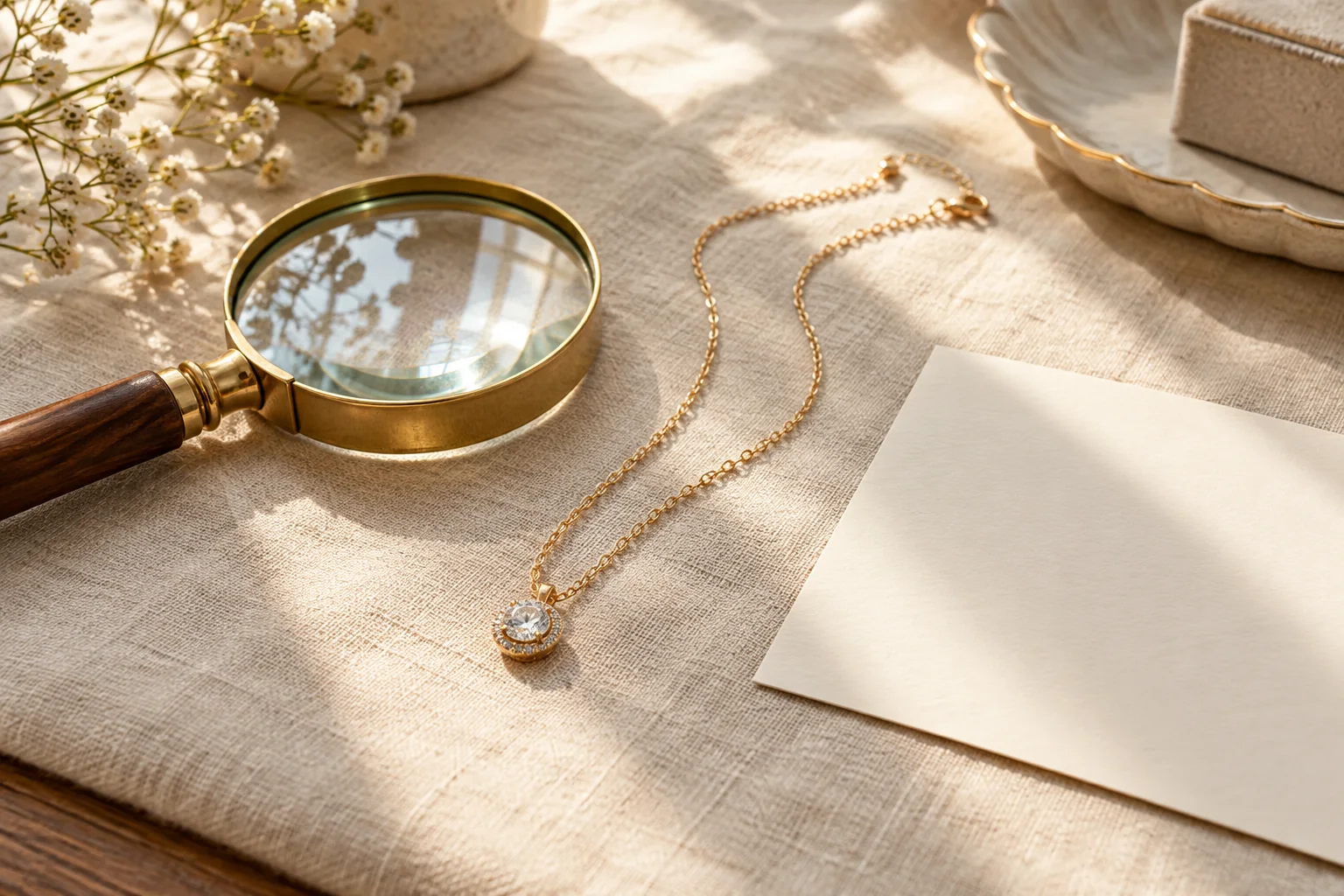
I make the question easy to assess
I state what I noticed without naming a cause I cannot establish. I might describe a dark patch, a cloudy-looking accent or a part that moves differently. I avoid calling it tarnish, corrosion or glue failure unless the actual assessment supports that description. A clear observation is more useful than a confident guess.
I include the product name and selected option. I share where the change appears and whether the item has been exposed to a cleaner or another substance. I give the full name of any product already used. I also explain whether I wiped, soaked, brushed or heated the piece, so the next advice can take that history into account.
I keep the item supported while I wait. I do not detach an accent to make it easier to clean. I also avoid opening rings or moving a setting to reveal a hidden area. I treat those actions as alterations, not ordinary care. I ask a qualified jeweler about an assessment when construction or repair is part of the question.
I do not ask for a guaranteed home remedy. I ask whether the maker has an approved method for the actual finished item, or whether it should be inspected before more handling. I keep a proposed cleaning step separate from a claim that a surface can return to its original appearance.
I save the answer with the product record. I can then follow its conditions and identify what it covers. I do not generalize a reply about one necklace to every stone or pearl-like accessory in my drawer. I let the actual item details determine the scope of the advice.
How do I store the necklace without mixing up its care needs?
I can put similar-looking necklaces together and forget which instructions belong to which one. Separate storage can make the next care decision clearer.
I keep the necklace's instructions with its product record and store each piece as its maker directs. I use separate supported spaces when appropriate. I do not assume that a storage additive, polishing cloth or sealed bag is suitable for every accent and finish.
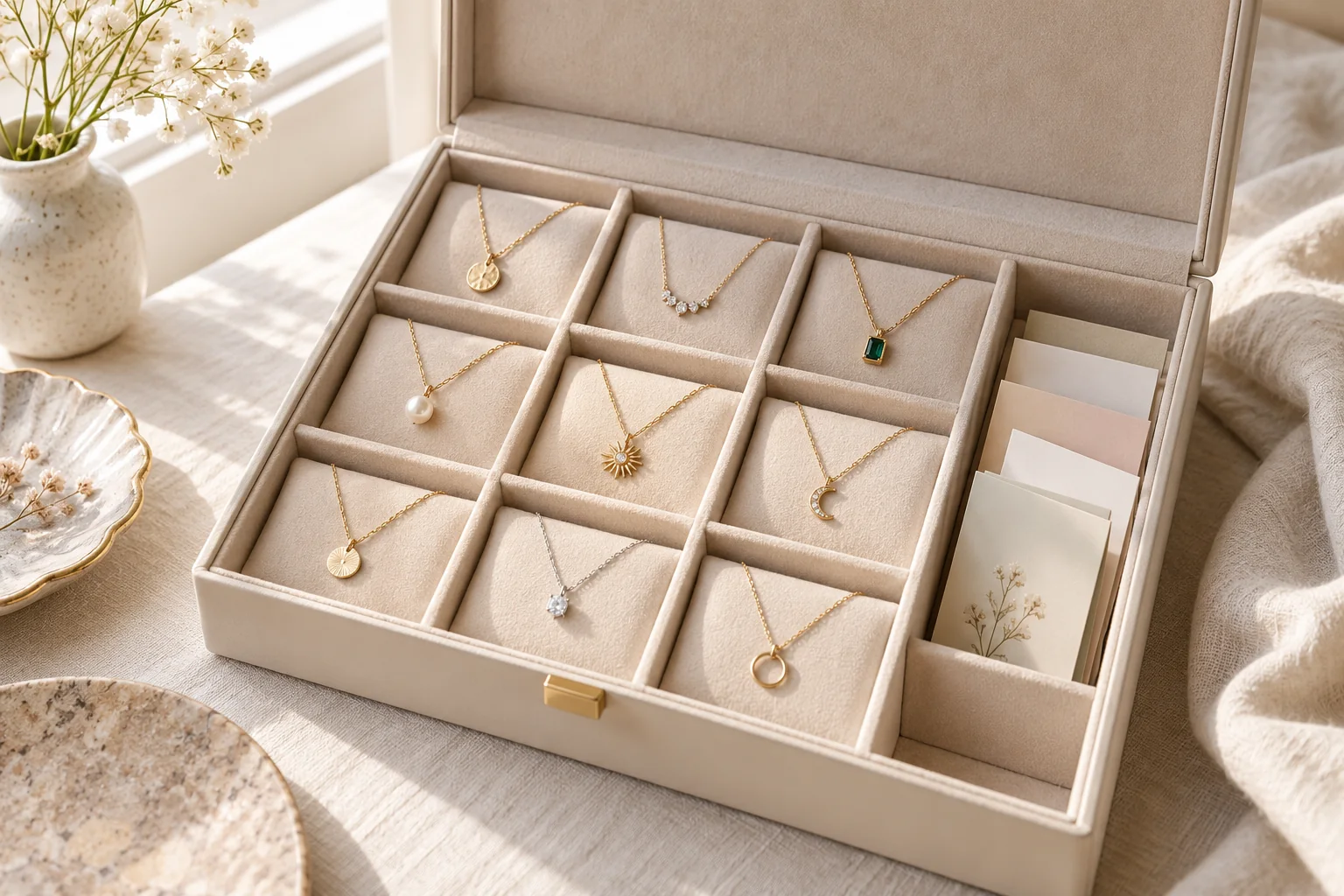
I organize by the actual item rather than color alone
I give each necklace an identifiable place. I can keep a small product card nearby or use a record that names the selected option. I do not need to attach a label to a delicate chain. I want to match the piece with its care instructions without dragging several necklaces out of a tangled pile.
I keep plain cloths separate from treated polishing cloths. I also retain cleaning products in their labeled containers. I do not place an unknown cloth or storage chemical in a compartment simply because another piece uses it. I check whether an additive suits the complete necklace before I introduce it.
| Storage detail I retain | Decision it helps me make |
|---|---|
| I name the exact piece | I can find the correct instructions |
| I identify any treated cloth | I avoid using it as a plain wipe |
| I keep care products labeled | I can review their intended use |
I use the necklace travel-storage guide when I need to move the item. I keep the same distinction between supporting the chain and choosing the right environment for its materials. I follow the maker's instructions rather than assuming all jewelry needs identical sealed storage.
I review the care record when I replace a product or add a new accessory. I do not transfer instructions because two pieces have the same color. I want the next after-wear routine to begin with the correct item information, a suitable surface and a clear method. I keep unresolved material details out of any shared cleaning plan.
Conclusion
I identify each part and follow the finished necklace's care instructions. I keep ordinary care, stain treatment and repair separate, and I ask before trying an uncertain method.
- GIA: Tips on Caring for Jewelry. I use its material and treatment cautions, not a universal cleaning recipe. ↩
- GIA: Pearl Care and Cleaning Guide. I keep its cultured-pearl guidance separate from glass or other imitation accents. ↩
Images are AI-generated editorial illustrations. They do not identify or verify a specific product.