
How Do I Read Stainless Steel and Gold-Tone Jewelry Labels?

I can read stainless steel and gold-tone in one listing and still misunderstand the piece. I need to separate its stated base from its appearance.
I read stainless steel as material information and gold-tone as a description of color. I ask for separate details about any finish, coating and other components. I do not infer gold content, coating thickness, lifetime wear or water resistance from those two terms alone.
I want a product description to help me choose and care for the actual necklace. I can make that description more useful by sorting its statements into clear questions. I do not need to become a metal tester to spot what a listing has not established.
What does a stainless steel base tell me about the whole piece?
I can see stainless steel and assume every visible part has the same construction. That shortcut can hide the details I need for care and use.
I check which components the stainless steel statement covers. I look separately at the chain, setting, clasp, pendant accents and surface finish. I do not assume that a base-material statement identifies every part or establishes a steel grade that the seller has not supplied.

I read the scope of the material statement
When I compare stainless steel jewelry, I start with the exact words on the selected product. I distinguish stainless steel base from a claim about a particular chain, setting or component. I do not fill a gap by borrowing the description of a nearby item in the same collection. I want to know which statement applies to the option I would receive.
I keep decorative parts in view. A pendant may combine a stated metal with a stone, glass accent or another material. I do not assume that the base describes those additions. I also avoid identifying a stone from a photograph when the written details do not establish it. I need the finished piece's description, not a guess based on its color.
| Wording I read | Question I still ask |
|---|---|
| I read stainless steel base | I ask which parts the statement covers |
| I read a named steel grade | I check that it applies to my exact option |
| I read a separate accent material | I include that component in the care decision |
I use our Textured Stainless Steel Chain Collection as a concrete reading example. Its current description states a stainless steel base and assorted gold-tone and silver-tone finishes. I can repeat those details. I cannot add a specific grade, coating process or thickness when the page does not provide them. I keep dimensions and weight tied to the selected style too. I read each supplied detail at its stated level instead of turning one clear fact into several unsupported promises.
Does gold-tone mean the same thing as gold plated?
I can treat similar-looking gold colors as the same material. I need clearer wording before I decide what the surface actually contains.
I treat gold-tone as an appearance description unless the seller supplies more information. I look for a separate, specific statement if a piece is described as gold plated. I do not translate gold-tone into solid gold, a named gold purity or a known coating thickness.

I keep color and composition in separate questions
I can enjoy the warm appearance of a necklace without claiming to know its surface chemistry. I read the color as one detail and the stated construction as another. I do not use the shade in a photograph to decide whether a surface contains gold. Different lighting and screen settings can change how a piece appears.
I look for wording that goes beyond appearance when that information matters to my purchase. I may ask what the seller means by a plated finish and whether further construction details are available for the selected option. I do not supply a process myself because a different retailer uses it on a similar-looking chain. I also do not treat a number in a title as a description of the whole necklace without reading what the number modifies.
I use the FTC's Jewelry Guides overview as context for accurate descriptions of metallic content, color and treatment.1 I do not use the overview as a certificate for a specific item or as my own laboratory finding. My practical task is to keep the supplied claims separate and ask about the ones that remain unclear.
I use our gold-tone and silver-tone styling guide when my question is which color I prefer with my clothes. I keep that styling choice distinct from a material choice. I can select a color I enjoy and still request clearer finish information before buying. I do not need to force those two decisions into one label.
Which finish details should I ask for before buying?
I can collect impressive material words and still lack an answer to my own question. I get more useful information when I ask about the exact piece.
I name the selected style and ask what the finish statement covers, whether the process is disclosed and what care limits apply. I ask for any available specifications that matter to me. I leave unanswered details open instead of converting them into assumptions about durability or performance.

I turn a vague concern into a narrow question
I write down why I need the information. I may want to understand whether a gold-colored surface is a stated coating or which part of the necklace a material claim describes. I can ask that directly. I do not start with a demand that the piece last forever because that request does not identify a construction detail the seller can show.
I include the product name and option number in the question. A collection may contain different links, sizes and finishes. I do not treat an answer about one style as confirmation for all of them. I check that the response identifies the same selection as the product image I have saved.
| Question I send | Information I want |
|---|---|
| What does this finish description cover? | I want the relevant component identified |
| Is the finish process specified? | I want a supplied fact rather than a guess |
| What care limits apply to this option? | I want instructions for the finished item |
I keep the reply with the listing details if I decide to order. I do not rewrite an uncertain answer into a stronger statement. I can decide that a missing detail does not matter to my intended use, or that I need more information before choosing. I make that decision openly. I also keep a visual preference separate from a claim about material value. I can like a finish without assigning it a composition, thickness or expected lifespan that has not been established.
How should I choose care when the surface details are limited?
I can search for stainless steel cleaning advice and overlook the finish or accent on my necklace. A method for one material may not suit the finished piece.
I follow the care instructions for my exact necklace. I include the finish and every stated accent in that decision. I avoid assuming that a stainless steel base permits soaking, abrasive polishing or household chemicals, and I ask the seller when the supplied care instructions are missing.

I let the finished item set the method
I read the product's care section before searching for a cleaning recipe. I may find instructions to wipe gently, store separately and avoid prolonged moisture or abrasive products. I follow the instructions actually given. I do not turn a general claim about a metal into permission to use a treatment on a coated or mixed-material piece.
I use GIA's care guidance as context for why different materials and treatments can need different handling.2 I keep that source separate from the selected necklace's instructions. I do not copy a method described for a particular gemstone and apply it to an unidentified accent. I also do not assume that an ultrasonic cleaner suits the piece because its chain looks sturdy.
I consider storage as part of care. I set the necklace down so that its surface does not rub against a pile of other pieces. I follow any supplied direction to store a chain flat or separately. I do not fold it sharply to fit a small pouch. I keep the storage choice tied to its construction as well as its finish.
I use our mixed-material necklace cleaning guide when I need to work through several components. I keep the actual method within the maker's limits. I do not scratch a hidden spot, use a magnet or apply a chemical as a home verification test. I can ask for clearer information without damaging the very item I want to understand.
What should I do if the wording and the item seem different?
I can notice a changed color and immediately guess what the necklace contains. I need a clearer record before I decide what that change means.
I save the listing, selected option and supplied material details, then document the actual concern in ordinary light. I ask the seller about the mismatch or change. I do not identify a metal or coating from color alone, and I avoid scratch tests or improvised repairs.
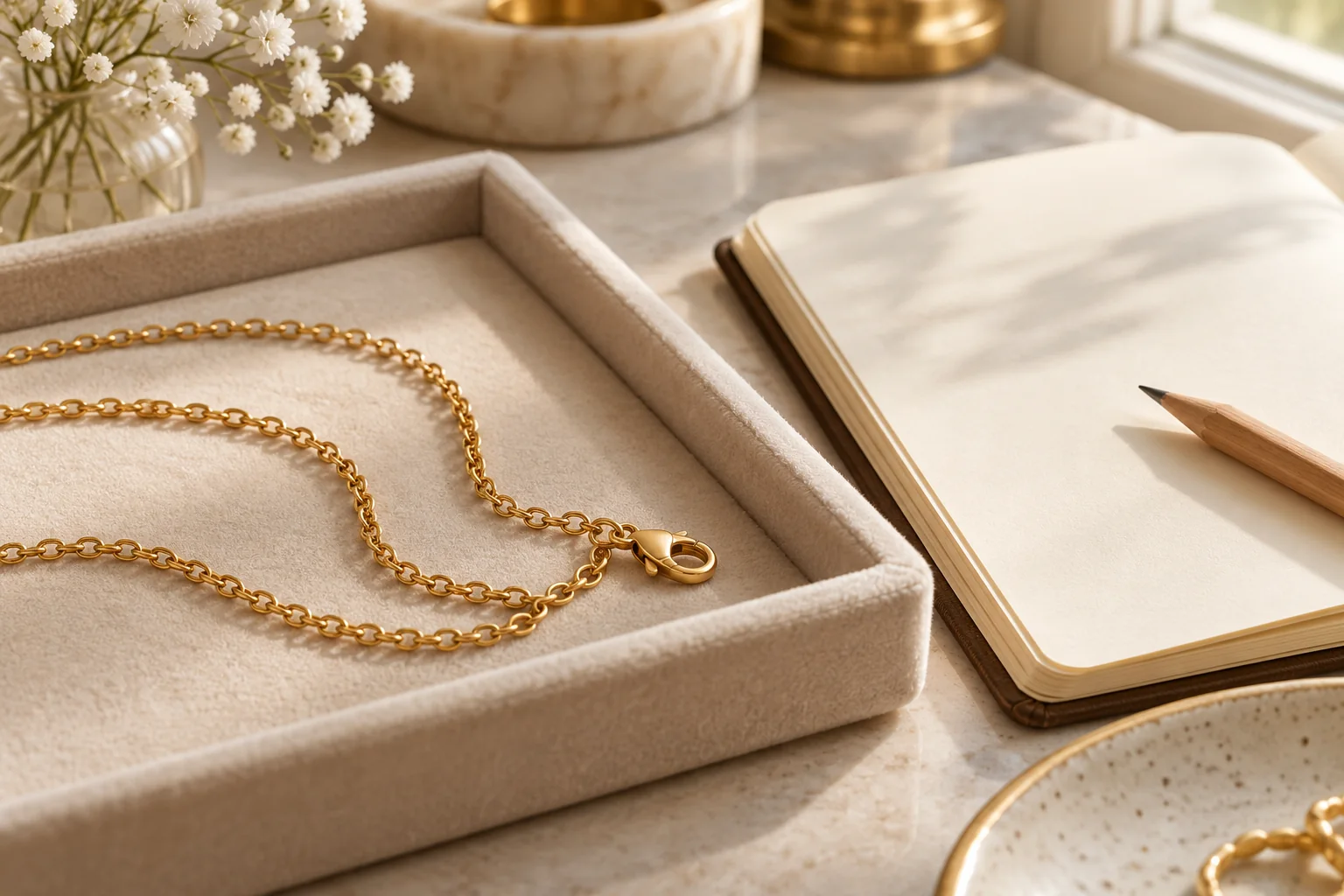
I preserve useful information before I seek an answer
I compare the received item with the exact option I selected. I check whether I ordered a gold-tone or silver-tone finish and whether the collection uses separate images for each numbered style. I do not compare two different options and call their difference a material problem. I want to separate a selection question from a change in the item itself.
I describe what I can see. I may notice a different shade in one area or a mark near a contact point. I take a whole-piece photograph and a close view without a filter. I avoid scraping the surface to make the difference more obvious. I also do not polish the area before asking which care method is suitable.
| Information I keep | Reason I keep it |
|---|---|
| I save the exact selected option | I can identify the item under discussion |
| I retain the supplied material wording | I can ask about a specific statement |
| I photograph the concern clearly | I can show the observation without altering it |
I ask for an explanation tied to the actual piece. I keep any policy question separate and read the seller's current terms rather than assume a particular remedy. I can request a qualified assessment when the construction remains unclear. I do not claim that a color change proves a specific base metal, coating method or misuse. I make my next decision from the available details and the reply, rather than from a confident label I have invented myself.
Conclusion
I separate base material, color and finish details. I ask about missing information and follow the finished piece's care instructions without adding claims the description does not support.
- FTC: Jewelry Guides. I use its accurate-description context for metallic content, color and treatment, not as certification of an item. ↩
- GIA: Tips on Caring for Jewelry. I use its material-specific care context while following the selected item's own instructions. ↩
Images are AI-generated editorial illustrations. They do not identify or verify a specific product.